Showing posts with label Blu-ray. Show all posts

Friday, February 03, 2017

Psychotronic Ketchup: The Witch Who Came from the Sea (1976)

The Witch Who Came from the Sea is not an easy watch. In climbing deep into the recesses of a mind wracked by a childhood full of sexual abuse – which culminates in an adulthood full of swinging sex and drug addiction – director Matt Cimber made quite the interesting counterpart to his later film, Butterfly… you know, the one that got Pia Zadora a Golden Globe award (and a couple of Golden Raspberries) but is generally considered to be one of the worst films ever made.

This is not the case for the far more interesting The Witch Who Came from the Sea, which is sparked by a frankly astonishing performance by Millie Perkins (an actress to whom I have paid little attention over the years), along with sharp, evocative cinematography, some of it provided by Dean Cundey, who worked on this film before performing the same duties on several of John Carpenter’s biggest films (Halloween, The Fog, The Thing, and Big Trouble in Little China), as well as filming the Back to the Future trilogy, Rock ’n’ Roll High School, Romancing the Stone, Who Framed Roger Rabbit, Apollo 13, and Jurassic Park.

Honestly, I would not have watched the film today except that my pal Aaron and I were discussing it early this morning, and he mentioned that he found the film streaming on Amazon, along with a couple of other titles which recently had gotten the Blu-ray treatment in something called The American Horror Project Vol. 1. The purpose of The American Horror Project is to recognize lost classics of the horror genre from the 1970s and then give those long-neglected films (some never even had decent VHS releases) restoration and high-end release to the public. The film’s selection for this honor instantly made us both realize we need to see it, but the cost of the Blu-ray set (well over $60, even with a discount on Amazon.com) is more than slightly prohibitive for both of us right now, with a new baby in his household and me without steady employment. Luckily enough, he found all of the three titles (the others being Malatesta’s Carnival of Blood and The Premonition) on Amazon’s site, and lucky me as well, I have a Shudder subscription on there so that I too can now watch and (hopefully) enjoy those films.

In the end, The Witch Who Came from the Sea is more of a psychological drama (its not, even with its murders and resulting police investigation, even really all that much in the thriller genre) than it is an actual horror film. Don’t get me wrong… there is violence within the film and it might indeed be troubling to some (it was one of the 72 films declared to be a “Video Nasty” and banned from England in the 1980s), and when you add in the nudity and sexual scenes, this is not a film for the kiddies or truly weak of stomach (and especially mind). Even though most of the more graphic violence is merely suggested and occurs offscreen (and the razor cutting scenes that are shown aren’t done all that believably), when the lead character gets around to murdering, her fallback move is that of castrating her victims. So if you are a guy and overly sensitive about your manhood, just repeat to yourself… no, never mind. You are just a big baby. It’s a movie and the violence is faked. Get over it.

The film has gained some controversy in the horror nerd realm for its appropriation of some Frank Frazetta artwork from the cover of an old issue of Vampirella. The face of the artwork was changed to that of Millie Perkins and she is holding a man’s severed head in the movie poster. The fact that such an image (or even a severed head) does not occur within the film itself seems to really set a lot of people who encounter this film on edge. And sometimes their reaction is such that they savage the film entirely without taking into account that The Witch Who Came from the Sea is a very sincere look at child abuse and the sexual politics of the 1970s. Since the film is most decidedly not a book, I guess the armchair critics feel justified in judging the film solely by its poster (i.e., cover) and its ability to deliver those goods promised by the image. But then, they aren’t taking into account that the elements within the image all are either discussed or implied within the film (seriously, the poster image makes perfect sense fairly early on in the film), whether an actual supernatural witch bearing a scythe manifests herself or not.

I had thought for a good while that I had seen the film before this morning, but discovered just a scene or three into the film that I had not. The Witch Who Came from the Sea bears slight thematic and title similarities to another 1976 film of greater note, The Sailor Who Fell from Grace with the Sea, which I have seen a couple of times (and which came into my life at the age of 12 when I saw a particular picture of a naked Sarah Miles (and that Kristofferson guy) getting it on in one of those “Sex in Film” annual recaps in the pages of Playboy). So a film with a similar title has been kicking around my head for a good while (though it would be about a decade more before I first saw it). When you take into account just how many horror films (and films in general) that I have seen in my life, I find it quite reasonable that I sometimes get confused when confronted with certain titles.

But now I have actually seen The Witch Who Came from the Sea on its own, and while it wasn’t really the horror film suggested by its garish, gaudy (but intriguing) poster artwork, it turns out that found the film a very worthwhile watch and one that is quite worthy of further discussion and study.

Sunday, November 22, 2015

Zappa Still Alive in "Roxy the Movie"

Roxy the Movie (2015)
Dir.: Frank Zappa
TC4P Rating: 7/9

Except for my brother Otis, I often feel quite alone in my regard for Frank Zappa, especially in 2015. Some of my friends have Zappa in their collections, but nobody that I am aware of listens to him on a regular basis like I do. And except for when I am with my brother, I have no one else in my life with whom to discuss Zappa and his work.

While I was aware of Zappa when I was a bit younger (I remember being fascinated by him when he hosted one of the more notorious episodes of Saturday Night Live), I did not own one of his albums until 1980. After hearing the song Dancing Fool on Dr. Demento's show, I purchased my first copy of Sheik Yerbouti on double LP (with that iconic cover photo of Frank in Arab garb), and I never looked back. Within a year, I owned seven more of his albums. I kept buying even more albums, anything that I could find in our local record stores. I followed every move Zappa made in the press, including his political misadventures, and it just made me feel even more connected to this music from what truly had to be another universe, though he was (tragically) human as anyone else, just prodigiously, ridiculously more talented and outspoken. At a garage sale in the mid-'80s, I picked up the very first Mothers of Invention LP, Freak Out, and after that, it was just a not so simple matter of filling in the gaps, owing to how crazily prolific he was, both in his lifetime and posthumously. Tupac has nothing on Frank.

It is now some thirty years later, and I have nearly every Zappa album -- official and otherwise -- around ninety albums in some form or another, LP, disc, or digital. I have read numerous biographies on the man and even his own autobiography, books of analysis and criticism of Zappa's music output, and magazines devoted to his legacy. The Zappa Wiki Jawaka is a regular online destination for research for me, and I also regularly listen to The Zappa Podcast, released sporadically throughout the year, which is the true apotheosis of Zappa nerdom. Zappa, like Lincoln, is never far from my mind.

And like many Zappa fanatics, it is the hope of discovering missing artifacts and long dormant music that spurs us through the years. For some, one of these artifacts being dangled on the end of a forty year old stick is Roxy the Movie, a concert documentary built from a quartet of performances in L.A.'s Roxy Theatre in December of 1973. The shows featuring the music of one of Zappa's justly renowned and finest ensembles were available on a double LP called Roxy and Elsewhere in 1974, along with selected tracks in the You Can't Do That On Stage Anymore series. (And even more from two of the shows on a 2014 release called Roxy by Proxy.) But what had happened to the movie that was being filmed during that set of shows?

Sound problems, man. Really, synchronization problems. Something got messed up, the timing on the sound in relation to the image went out of whack, and it took forty years (with shifting focus on Zappa's part until his death in 1993) to figure the mess out and release a finished film out of it. Editor John Albarian was brought in to sort through the wreckage. As he puts it in the liner notes, " Four shows multiplied by four cameras multiplied by 80 minutes equates to about 21 hours of picture and sound that needed to be sunk together but couldn't due to their difference in speed." It took him over eight weeks to figure out what needed to be done to get the film and sound to play together nicely. Then he had to cut the film together.

And what we have is what we didn't have before. Criticism is fairly useless, because you can't go back and have Frank do it all over again. We were missing this, and now we get to see it in all of its ragged glory. If you are not already a convert to the cult of Zappa, I am not sure if maybe Baby Snakes is the better entry point film-wise, but Roxy the Movie does show off one incredible band on some of Zappa's most complex (and therefore, difficult to play) pieces.

The Band:

  • Napoleon Murphy Brock (flute, tenor saxophone, vocals)
  • George Duke (keyboards, synthesizer, vocals)
  • Bruce Fowler (trombone)
  • Tom Fowler (bass guitar)
  • Ralph Humphrey (drums)
  • Chester Thompson (drums)
  • Ruth Underwood (percussion)
  • Frank Zappa (lead guitar, percussion, vocals)
Zappa, after discussing sound problems with the audience (certainly presciently), launches into a discussion of marital aids that leads into Penguin in Bondage. Next is the percussion-heavy T'Mershi Duween, followed by a medley jamming together The Dog Breath Variations and a section of Uncle Meat. Excellent renditions of RDNZL and Inca Roads give the entire band a workout before leading into one of my favorite numbers from the film, Echidna's Arf (of You), with its manic start-and-stop rhythms. 

Most impressive for me in the film was getting to see Ruth Underwood attempt some insanely intricate vibraphone, marimba, and xylophone parts in several songs. This is especially true in the next number, Don't You Ever Wash That Thing?, where Frank even calls attention to her at one point when it is her turn to shine (though she has already been going crazy on percussion the entire time). She is clearly very caught up in the concert and has a definite rapport with Zappa onstage. 

Next up is Cheepnis, a number clearly close to Zappa's monster-movie loving heart (and mine). He introduces the number with a lengthy discussion of the Roger Corman film, It Conquered the World (that I just watched again right before Halloween), including a description of its absolutely silly monster. As Frank describes it, "The monster looks sort of like an inverted ice-cream cone with teeth around the bottom. It looks like a... like a teepee or... sort of a rounded off pup-tent affair, and, uh, it's got fangs on the base of it. I don't know why but it's a very threatening sight. And then he's got a frown and, you know, ugly mouth and everything..." Napoleon Brock Murphy's lead vocals tell us the tale, but the middle section with the squeaky vocals describing the giant poodle attack (my favorite part of the song) is completely missing from this version, though the full song does appear on Roxy and Elsewhere. [Note: The poster art (and blu-ray cover art) for Roxy the Movie is itself a takeoff on the original poster for It Conquered the World.]

The show closes with a quite lengthy (17 minutes) version of Be-Bop Tango (Of the Old Jazzmen's Church). Zappa stresses that he wants to make sure they get this take right, and tells the audience, "This is a hard one to play," and then adds with a smile (even though he does play guitar during it), "That's why I don't play it." Clearly meant to stretch the limits of his orchestra, the entire band is up to the task, but in this number, it was the twin drum playing of Thompson and Humphrey that stood out for most for me, as well as jazz giant George Duke on keyboards. The song itself devolves into a weirdo dance contest with members of the audience (and one ringer stripper, who is really not that good) trying to keep up with whatever wild cacophony the band can play. It's truly stupid but also fun in its way, even if it goes on too long. Still, as a record of a Zappa concert in 1973, it is pretty accurate, even if there is an element of "you just had to be there" to get it.

If there is a criticism on the film from me, it is one how Zappa's guitar playing is not showcased as well as I thought it would be. He is rather jammed into a corner of the stage, and oftentimes the camera appears behind his guitar so we don't really get to see him play from that position. He looks cool, sure, but if you are trying to study the man and his style, he is often not afforded the most opportune of angles. Still, Zappa himself is his charismatic best onstage in Roxy the Movie, and fully in control of both the band and his audience in that neo-game show host voice that he perfected.

Extras on the disc include three additional song selections, totally around 20 more minutes, not included in the film. One song has another dance segment, this time involving groupie supreme, Miss Pamela Miller (one day Mrs. Des Barres), who is given the highly misogynistic task of sexually titillating the band members (even taking a crack at Ms. Underwood) to distract them from their playing. One could be taken aback at this behavior in 2015, but again it falls into the category of accepted behavior for 1973 (and well afterward) and comes off less dirty and more innocent silliness than it would seem. And besides, in a time capsule aspect, it is easy to see what was so appealing about Miss Pamela. She was a lovely girl.

And now I have another addition to my extensive Zappa catalogue, not just by having Roxy the Movie, but also because the Blu-ray comes with a second disc with the soundtrack to the film. Will the onslaught of Zappa releases ever end? I certainly hope not, and I am fairly certain that his recorded legacy will not only outlast the impending 25th anniversary of his death in 2018, but also probably my own demise. Hopefully someone will invent a way, besides identity theft, for me to purchase new Zappa albums when I am dead and buried. Just pipe the music into my coffin...

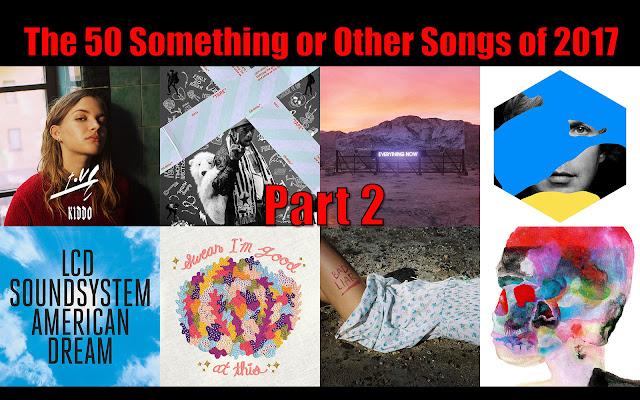
The 50 Something or Other Songs of 2017: Part 2

In our last exciting episode, I reviewed tracks 50 through 31 on Rolling Stone's list of the Best 50 Songs of 2017 . How did those ...