Wednesday, October 07, 2015

Recently Rated Movies: A Hodgepodge of Varied Horrors

I watch a huge variety of films throughout the year, in nearly every possible genre, and from nearly every decade in film history. My need to complete any number of film lists (some from other sources and books, and some of my own devising) has me hopping about in nearly every possible direction to check ever more films off of those lists in a relatively consistent fashion.

However, around September and October, my choices tend more towards horror and science fiction, or variants thereof. It is the one time within the calendar year where I actively try to keep within those genres exclusively. Hence, the trio of absolutely unrelated films that I have seen over the past week, reviewed briefly below...

The Beast of Borneo (1934)
Dir: Harry Garson

TC4P Rating: 3
None of this nonsense is in this film.

"Ve've got to haff an O-rang!" The gorilla in the poster at the right is not in this film, nor is the scantily clad woman lying prone in the picture to the gorilla's right. As for the "gorilla gland injection" mentioned at the picture's bottom, it too is not to be found in The Beast of Borneo, for the ape in residence within its frames is an actual orangutan, not a guy in a suit (for the most part; there are a couple of scenes where it is obviously so), and it is never represented as a gorilla. I suppose gorillas were generally scarier to the movie-going public in those days (it was not long after the mighty Kong came and went), but this film employs footage of real orangutans and works them into its story.

A lot of the orangutan interest early in the film, before it bogs down in its melodramatic story involving a mad Russian scientist who wants to hunt an orangutan in Borneo in order to prove his theories on an evolutionary link between humans and apes, seems to be on the orangutan's ability to make a certain noise. That noise is shown in the film to be a low, elongated growl crossed with a yell. It sounds remarkably human to my ears, and it wouldn't surprise me if the sound effect in the film was created in a studio by the human voice. In my limited experiences in zoos and watching nature videos, while orangutans are certainly cable of long, low growls, I have never heard the noise portrayed in this film come from an orangutan, and a quick search online revealed nothing that replicated it. To me, the noise reminds me of the start of the novelty rock song, The Crusher, by the Novas, from 1964. (Not sure if orangutans can do "the Hammerlock" either, but if they don't, they're a bunch of turkey-necks.)


On the brief Wikipedia entry for The Beast of Borneo, it is mentioned the film is "made up mostly of leftover footage from Universal Studio's 1931 'East of Borneo,'" but there is no source cited for this information, nor does any such connection between the two movies appear on the page for either one on IMDb. I would think that, were this true, somebody on IMDb would have included it in the trivia section on either page. At the very least, The Beast of Borneo provided me with the directions by which discovered other items within my range of interest. It provoked me to do a direct search for East of Borneo (which is a very striking movie in many ways) and finding that film online also made me run into the fascinating story of the surrealist film made about lead actress Rose Hobart by artist Joseph Cornell from a print of East of Borneo, also named Rose Hobart (1936).

Of The Beast of Borneo itself, it is very low-budget, crude, has horrid sound, and exists primarily in the public domain, with the ups (easy access) and downs (poor, unrestored prints) in viewing that entails. The acting is the stiff standard of its quality level, but it is not unentertaining. Much of the fun in the picture comes from a baby orangutan who is as adorable as hell and is very proficient in extricating himself from any knot imaginable. The film is also just over an hour long, so despite the crawling slowness of the talky scenes in building the thin plot, it flies by swiftly enough. You get some mild jungle thrills, and that is all. And if you are me, you get pleasantly reminded of The Crusher... RRRRRRRRAAAAAAARRRRRRRRGGGGGHHHHHHH!


Hell Baby (2013)
Dir: Thomas Lennon & Robert Ben Garant
TC4P Rating: 5


I thought this one was in the bag. Or, in the womb, as it were...

I am fond, to varying degrees, of a large number of comic actors working in the entertainment field these days. A good many of them come from The State, the MTV sketch show that was relatively short-lived, but has had a zillion other shows and movies spring from the creative minds of its talented cast over recent years. 

Two of these cast members, Thomas Lennon and Robert Ben Garant, had a very successful turn in creating the Cops spoof, Reno 911!, but have had even greater success as the screenwriters of films in which I have very little interest: The Night at the Museum series, Taxi, The Pacifier, Balls of Fury, and Herbie: Fully Loaded. All of these films, while panned critically by a majority of film critics, made money, which is the most important part if you want to continue writing in films. Except for Let's Go to Prison, which was not a financial success, I have had little interest in these films (there are two on this list I have yet to see), and Let's Go to Prison mostly sucked. But Lennon and Garant were having mostly hits with very few misses as far as the bottom line was concerned.

But then came Hell Baby. Not only were Lennon and Garant co-directing the film this time (Garant directed the Reno: 911! movie, which I loved, but you have to be a Reno fan to appreciate it -- filmgoers didn't generally), but they have prominent roles as ass-kicking Vatican exorcists. Hell Baby seems to be right in my wheelhouse, and they stacked it with comic actors, as I mentioned at the beginning, for whom I hold a great fondness: Rob Corddry, Keegan-Michael Key, David Wain, Michael Ian Black, Rob Huebel, Paul Scheer, Kumail Nanjiani, and a tasty Riki Lindhome. And best of all, from the trailer I saw a couple of years ago, Hell Baby held promise of being a fun horror comedy. I thought it was a sure winner.

I'm not sure why I put off seeing the film ultimately, but it doesn't matter. Hell Baby is never as good as you hope it will be, though it is not a chore to watch. It's really just standard. The actors perform at the top of their abilities, but the story never jells. Scenes go on for far longer than they need to; I suppose they are going for the uncomfortable vibe of much comedy these days, used successfully on many Adult Swim programs that star many of these same actors (Children's Hospital, as an example), and perhaps that shortened format seems to work better for the style. Here, it just makes the film grind to a halt again and again. Lennon and Garant as a team are the best part of the movie, but that is onscreen, and even there, the priest characters (while having most of the funniest lines) get a little overplayed (yes, I get it... these priests love strippers).

And can we have a moratorium on movie characters getting run down by motor vehicles from out of nowhere for comedic effect? At least it is not a bus speeding at an insane rate of speed for a city street this time. (I really, really hate when that happens...)


Pernicious (2014)
Dir: James Cullen Bressack
TC4P Rating: 3

NOT the poster on Netflix
mentioned in the text.

Let's play pretend for a bit. Let's say that, chiefly because I get obsessed with the sound of various words, that I became uniquely driven to locate a movie with the unlikely name of Persnickety on Netflix. Instead, I undershoot in the alphabetical order a tad and end up seeing something called Pernicious instead.

OK, that's not how it happened. It was actually, "Hey, let's see what horror movies have been added to streaming. Pernicious? What a stupid title. Oh, cute girls on the cover in various states of undress posing with a creepy Asian goddess statue. Seems dumb and quick. Let's watch it." I wish that I were beyond such measures, but there you go. Just a dopey male driven by libido like the others. 

Pernicious lost me almost from the start, and at no point did it come close to winning me back. Its opening scene has the actresses speaking what is probably vapid dialogue over the opening credits, but no sound emits from their eating orifices as they travel from America to Thailand, and take a boat downriver. We only hear some cheap music played, and are left not hearing their voices until they arrive at the house in which they will be staying while they serve as teachers at a local school. Not sure what a couple of them will be teaching, as they seem mostly idiotic except for the brunette (naturally). Such cliches don't matter, as one of the girls will blankly remove some sort of amulet from a small spirit house perched outside of the abode, the trio of idiots will discover the creepy gold statue of a prepubescent girl in the attic, and then will deal with the spirit within that statue as it seeks revenge for being murdered as a little girl so many years before.

That's the plot in a nutshell. You think you are getting an "Americans abroad encountering a crazy Asian ghost's bloodlust" movie, much like in The Grudge, and you do indeed get that. But the film takes a weird turn about a third of the way in when the girls run into a trio of British ex-pats in a bar, and the turn is on the level of the way From Dusk Till Dawn shifts midway through that film, but in even less of a positive way. Even though the ghost movie that is occurring never goes away, and in fact, comes back even stronger in the second half, Pernicious briefly swerves into full-on torture porn territory, as the girls, after seemingly being "roofied" by the Brits, suddenly have the boys tied up in individual rooms and slowly and methodically torture and kill them as bloodily as they can. Eyeballs are gouged and force-fed, body parts sliced, teeth yanked... this might hold appeal for certain fans of extreme filmgoing, but for me, it was all wrong tonally when matched against what comes before it and what comes after it. It is like you fell asleep watching Pernicious on cable, woke up in the middle of another horror film, fell back asleep, and were catching the rest of Pernicious on its next showing.

The other problem is that soundtrack. Not just the lack of dialogue over the credits when all of the characters are clearly having conversation, but later in the film when two of the local residents have a full scene speaking Thai, which is pretty important to the plot, but there is not even the slightest impulse to put subtitles on the screen for the majority of the world that does not speak Thai. It is fairly easy to tell what is implied by their dialogue, especially from the actions that happen both during and immediately after, but really... it seems like lax production. 

Speaking of which, at the end of an important expository scene with a local "witch," there is a split-second of cacophonous noise that bears no relation to any other sound in the scene nor to the score of the movie. It is just sheer slopping sound editing (or film processing, take you pick), and adds to the notion that this film has an unsteady captain at the wheel.

Tuesday, October 06, 2015

Visiting and Revisiting: John Badham's Dracula (1979) Pt. 1


Welcome to the first edition of a new shared column by The Cinema 4 Pylon (Rik Tod Johnson) and Working Dead Productions (Aaron Lowe) called Visiting and Revisiting

The focus of this column, intended to be a semi-regular feature on both our sites, is to review films that one of us has already seen, possibly even multiple times, but the other has somehow put off watching over the years. Sometimes we get surprised when one or the other has not seen a fairly well known film, so we felt this was a good way to not only give the film either a fresh or updated viewing, but also to allow us to discuss the film at length afterwards.

Rik: The film we have at hand today is the 1979 version of Dracula, starring Frank Langella, Laurence Olivier, Kate Nelligan, and Donald Pleasence, and directed by John Badham. A little background is probably necessary before we begin. 

The 1977 Broadway version of Dracula with Langella was a revival of the original play adapted from Bram Stoker’s 1896 novel by Hamilton Deane and John L. Balderston, and used most famously for the 1931 adaptation with Bela Lugosi. The sets were even designed by the wonderfully ghoulish artist, Edward Gorey. The show only received mixed reviews, but it was the very definition of a monster hit, and Langella would be nominated for a Tony Award as Lead Actor in a Play. Talk turned eventually to a film version, but Langella had misgivings, and would only do it if they promised to work by his own guidelines for the character. Once Langella was on board to play the Count again in a new Universal film version, the play was given a nearly complete rewrite by W.D. Richter (who would go on to write and direct The Adventures of Buckaroo Banzai Across the Eighth Dimension, co-write Big Trouble in Little China, and direct Late for Dinner, three favorites of mine). The director, John Badham, was on fire in Hollywood at the time of this film, having previously directed the Oscar-nominated Saturday Night Fever. After Dracula, he would be best known for WarGames (1983), Blue Thunder (also 1983), Short Circuit (1986), and Stakeout (1987). On a side note, his younger sister, Mary, played Scout in To Kill a Mockingbird (1962).

Aaron, you have never seen this film before. I generally assume you have seen most of the major horror films that have been released. Any solid reasons why this one slipped by you?

Aaron: There are probably a couple of major reasons I've never watched the 1979 version of Dracula before today. Despite a fairly serious high school Goth phase that included plenty of Anne Rice novels, I've never been a big vampire fan. I understand the appeal, and yet, I don't find them inherently interesting in the same way I enjoy other monsters. Sure, plenty of good-to-great vampire films exist, and the original Bram Stoker novel is quite enjoyable, but even my favorite vampire films don't enjoy the level of attention in my house as, say, some of the Frankenstein films, or the Invisible Man, or the Creature from the Black Lagoon. 

I also had an image in my head of what this film would be like, probably inspired by a less-than-flattering VHS cover in the local video store. I had it in my head that Dracula would be a late ‘70s cheese-fest, full of chintzy sets, histrionic acting, and dated special effects. It turned out, happily, that I was wrong on all counts. Or nearly wrong on all counts, which we'll get to in a minute. Also, the film has a curious lack of reputation. It doesn’t seem to get mentioned a lot, and I never see it in any lists or discussions of vampires in film. The fact that I simply haven’t heard much about it, combined with how much I read about horror movies, led me to assume the film had been a forgettable flop. I was pleasantly surprised by the final results, and am more than a little annoyed I hadn’t sought the film out before now. But that seems to be a theme with this year’s Halloween viewing: seeking out and watching those big titles (or medium titles) that have somehow slipped under my radar.

You have a more extensive history with the film, Rik. Why don’t you tell us a bit of your background with it?

Rik: In early 1979, when I was 14 years old, my attention was caught in a rather significant way by a television advertisement for the upcoming feature film version of Dracula. In the ad, Dr. Van Helsing, played by Sir Laurence Olivier, holds up a Eucharist in order to keep the dread vampire at bay. Count Dracula, played by Frank Langella, hisses a single word, “Sacrilege!” before hightailing it away from Van Helsing.

This commercial played repeatedly over a couple of months, and I loved it. Any time it came on, as soon as Van Helsing would hold aloft his supposedly holy weapon of choice, I would shout, “Sacrilege!” with all the vigor of the man portraying the monster in the film. Then it went beyond the commercial. I do recall riding about with my mother and brothers one afternoon, and when my mom held up a finger to flip me off for saying something in that way that I do, I yelled “Sacrilege!” once more. Her reaction was to ask me, “Do you even know what that word means? Maybe you should know before you run around shouting it.” I did know what the word meant, but she stopped me dead with her response, and I remember it shut me up for a brief time.

I was, at that age, in the throes of a burgeoning interest in horror films, and especially in the Hammer films I was seeing late night on a local show called The World’s Most Terrible Movies. Just a couple of months earlier, my mother had taken me to see George Hamilton as a disco-dancing Dracula in Love at First Bite, which was a huge comedy hit at the time. But this new Dracula was rated “R” and we had not quite moved from Eagle River to Anchorage, where the movie theatres were. To see a film required special effort and a drive 15-odd miles away. Film viewing usually occurred in conjunction with a weekend’s outing for shopping that went beyond supermarket necessities, or when we spent alternate weekends with our father who had moved to Anchorage. Unfortunately, talking him into an R-rated film was impossible unless it had Clint Eastwood in it. Thus, alas, I did not get to see John Badham’s version of Dracula in a theatre in 1979. It would not be until the film came out on VHS that I would get my chance. And I have seen it several times over the years since.

So, Aaron, what were your impressions of this version of Dracula upon watching it?

Aaron: The Dracula story is so ingrained into popular myth that just about everyone could recount the basics of the tale, which is one of the reasons this film is such a surprise. My knowledge of the stage versions of Dracula is almost nonexistent, so I wasn’t able to spot what came from the stage and what was altered. But in this film version, it almost feels like the screenwriters are remixing Bram Stoker more than they are adapting him, taking the familiar elements and shifting them around to tell their own version of the story.

The film completely drops Jonathan Harker’s ill-fated trip to Castle Dracula, opening as Dracula is already en route to London on board the Demeter. Although most of the basics of the story still remain, many of them appear in slightly different configurations. Lucy and Mina seem to have switched names, so that Lucy is Jonathan's beloved, and Mina becomes Dracula's first proper victim, with the added wrinkle that she is now Abraham Van Helsing's daughter. Dr. Jack Seward, instead of being one of Lucy’s multiple suitors, is actually Lucy's father in the film. Quincy and Arthur are nowhere to be seen in this version, but I think they’re usually left out of the screen versions anyway. I'm assuming that many of these alterations are imported from the stage version of Dracula. Either way, it provides for a nice streamlining of events, in order to confine the novel’s multiple perspectives into one singular, linear story.

Rik: In the play, the characters of Mina and Lucy are combined as “Lucy Seward”. There is no Mina. I guess they resurrected her from the dead for the film, and, as you pointed out, switched her part with Lucy. 

What do you think of Langella’s choices for the character, such as no blood on his mouth, not fangs, etc?

Aaron: I think those were absolutely the right choices, and I’m glad he insisted on them. They not only add to the character’s elegance and believability as a menace, they serve to highlight the differences between him and the other few vampires we see in the film. The other, lesser vampires are sickly looking, rotted, with pallid complexions and pitch black eyes. They look marvelous, as ghouls, but also pathetic in a way. Had Langella put in black contacts or a pair of fangs, it would have turned his Dracula from a believable member of ancient aristocracy into a cheap Halloween costume.

Rik: However, if you and I showed up for a Halloween party dressed exactly as Langella’s Count, sans fangs and blood, it would look precisely like the cheapest Halloween costume imaginable.

While I do greatly enjoy the lush romanticism of the film, what I especially love is just how dark Dracula is, not only in the mood and atmosphere, but also in its physicality. The edges of the screen loom around your eyes while you watch it. You know five minutes in that this is not going to be an easy ride and there will be little in the way of comic relief.

My sense of the film to this day is that despite the violence of the storm in which Dracula lands in England, and despite the deaths of the crew that brings him there, that the Count rather improves the place (briefly) with his arrival, simply by his elegance. We are made to believe that the older continent from which he comes and the modern (as in the 1890s), civilized world appear to be equally decrepit. The civilized world is almost entirely showcased within the confines of an insane asylum, and we hear the screams of its manic inhabitants throughout the film, as even greater chaos erupts. Whatever pretense of civilization that exists in the living quarters of Dr. Seward and his family is merely a very thin veneer, and Dracula’s appearance punctures that fabric.

Langella’s Count is the ultimate smooth operator, speaking lowly in a seductive, measured purr and staring deeply but with a hint of softness into women’s eyes. You believe quite easily that he can seduce anyone even without supernatural aid, though that is surely a factor. However, it is lucky for humanity that the males in his presence aren’t buying it, otherwise the film would just be a bloody romance.

[To read Part 2 of Visiting and Revisiting: John Badham's Dracula (1979), click here.]

Monday, October 05, 2015

Return of the Son of Terrible Movies Promo Blowout! [Pt. 1]

In the beginning there was The World's Most Terrible Movies...


If you lived in Anchorage, Alaska and its environs in the 1970s and liked to stay up super late on Saturday nights, then you might remember the above clip. You also may well remember The World's Most Terrible Movies (and its spinoff, Son of Terrible Movies) which ran late nights on weekends on Anchorage, Alaska's ABC affiliate, KIMO-TV (Channel 13) in the 1970s.

The clip above is one of the opening segments used for the show, which ran older horror and sci-fi films, including many Hammer horror classics and Ray Harryhausen adventures, when I was a teenager. While I had many influences in my youth, The World's Most Terrible Movies is probably the #1 reason I became a fan of fantastic films of all types. [To learn more about the show and how I obtained these clips, click here.]


My interest in fantastic films was already apparent when I was relatively young, but seeing those Hammer and Harryhausen flicks on Saturday evenings blew it up huge for me. The World's Most Terrible Movies is where I met Christopher Lee's Dracula, Frankenstein's Monster, and Fu Manchu, where I first watch cowboys attempt to snare Gwangi in their lassoes, where I saw Sinbad and Jason fight animated skeletons, and where I learned who Peter Cushing, Barbara Steele, and Paul Naschy were. Most importantly, it's also where I fell head over heels for Raquel Welch in a fur bikini.


I guess we all have those moments in our youth where the mind expands after we have discovered something that perhaps we probably shouldn't have. For some people, that might be drugs, alcohol, or adolescent sexual stirrings that get taken farther than they should at the time. And for some of us, we find the cinema of the bizarre, of cult directors, under-appreciated actors, and twisted genres. I think we are the smarter and luckier group.


Vampires, giant monsters, wolfmen, robots, go-go girls, mad scientists... they act interchangeably as our priests and our demons. Movies move far beyond a mere entertainment for our kind. We recognize early on that, when the rest of the world denies us, the movie theatre is where we can go to submerse ourselves in other worlds for comfort. (But not guidance... no, that is probably not the wisest thing.) And once we have walked through those doors, we can't go back. The mind changes immeasurably. Things cannot be unseen. Or as Pauline Kael put it, "I lost it at the movies."


More than anything, movie showcases like The World's Most Terrible Movies held open those doors for me. And I have never gone back, nor have I tried. And through horrid jobs, a bad first marriage, moves across the country, and frustration at nearly every turn in my life (like all of us have), I know that I can make the pain go away by the simple push of a button or the purchase of a ticket. And when I hear the sounds of the opening fanfare that announce the film is starting, I might just as well be back in my living room in the pitch darkness at age 12, covering every inch of my body with a giant blanket except a small slit in front of my eyes through which I can watch the television screen, waiting for The World's Most Terrible Movies to begin.


To be continued later this month...

Sunday, October 04, 2015

Chopped into Pieces by "The Editor"

The Editor (2014)
Dir: Adam Brooks and Matthew Kennedy
TC4P Rating: 7


"A woman’s eyes weren’t meant to see such things, you understand?"

Ah, giallo! If you are not already a fan of these peculiar psychological thrillers from Italy (chiefly made between the late '60s through the '80s), then you will probably miss a lot of the fun in The Editor, a loving tribute to this odd and extremely misogynistic subgenre from Canadian filmmakers Adam Brooks and Matthew Kennedy.

Giallo, which is the Italian word for “yellow,” is meant to conjure up an image of old pulp magazines (often with yellow paper) that contained generally lurid tales of murder, detectives, and the mysteries they were solving. The Italian directors Mario Bava and Dario Argento are most often cited as the godfathers of the genre on film, and while the giallo subgenre has largely wilted into obscurity for the most part, there have recently been a handful of cinematic homages to the spirit of giallo.

A pair of films, both of which I admire, from French filmmakers Hélène Cattet and Bruno Forzani have led the charge. The first, Amer, released in 2009, is a wildly surrealistic and largely plotless fantasy that recounts the coming of age of a young woman, albeit using the sex, violence and gore that are hallmarks of the giallo tradition. The second, The Strange Colour of Your Body’s Tears [L'étrange couleur des larmes de ton corps, 2013], is equally as colorful and wildly rendered, but attempts (not completely as a success either) to marry more of a plotline to the gorgeous photography and extreme violence. Both films are remarkable for their imagery, but they chiefly use elements from giallo to incredible effect without actually existing as true examples of giallo.

In 2012 came Peter Strickland’s Berberian Sound Studio, which takes place in a studio in Italy that produces giallo films, and which tells the tale of a sound engineer from England (played by Toby Jones, who is near perfection in the film) forced to work on the sound effects of a film, who finds himself losing control of his sense of reality. The film is stunning simply as a horror film, outside of subgenre, but does gain a lot of atmosphere from the plot relationships to the world of giallo.

Even playing off of the same influences as those other tributes, The Editor is a different breed of cat. While the film is has as amazing a color palette and brilliant cinematography as the other recent homages to giallo, The Editor's attention is focused doubly on two things, not mutually exclusive of each other: outrageous violence and laughs.

Rey Ciso (played by co-director/co-writer Adam Brooks) is a veteran editor who had a mishap while making an attempt at editing the world's longest film for a legendary film producer. He accidentally chopped off four fingers on his hand with a paper cutter, and now wears wooden replacement fingers. Married to a former film star (played by a very icky Paz de la Huerta), Rey is unhappy, potentially suicidal, and is stuck working on a very low-budget giallo film. Suddenly, actors in the film are being cut down by a maniacal killer, and the only evidence they have in common is that the same four fingers from their hand that Rey chopped off of his are being left on the ground at each murder scene.

Enter Lt. Peter Porfiry, played to the hilt by the film's other co-writer/co-director Matthew Kennedy. (He is described by one character in the film, appropriately, as a young Donald Sutherland.) Porfiry is convinced from the start that Rey is his man, and will ignore any evidence to the contrary (and there is plenty of it) in his lust to bring Rey to justice. Rey himself is being tempted by the unbridled adoration of his comely assistant editor, Bella, who is also obsessed with finding the murderer. But the murders keep piling up, and Rey is ever so swiftly heading towards another nervous breakdown of the sort that once landed him in a mental hospital.


The producers within the film are insanely casual about each loss to the cast and crew, and are always ready almost immediately to insert an even less talented replacement. Even with the film, this is not unnoticed. The editor asks his producer at one point, “Where do you find these people?” One can only imagine the ultimate horrid end product of these recasts, as the film they are making is seen to be ridiculous from the start, though only slightly less silly than the “real world” the film proper projects.

I like that when a new editor is brought in to complete the film, he consults the index of a textbook on film editing for help while working on a scene which contains a tarantula. “Ah, here it is. Tarantulas and film editing.” Of course, he is about to be attacked by one of those very same spiders just before the killer feeds his guts through the editing machine, but at least he had the right book at hand.

The Editor hits the ground running with outlandish lines, both in the film they are making, and in the world in which the story exists. The big gimmick here is that the entire movie is dubbed poorly intentionally so it plays like the real giallo films are in actuality. The actors give straight-faced line readings of dialogue like "And if you scared me to death — the lead actor — how then would the film be finished?" and "I’ve heard these old studios are full of ghosts, and I’ll be damned if I’m gonna let myself see one!," and they get away with it. And the lines keep coming, left and right, straight through to the end of the picture.

It’s a world where the fraternity of men is far more important to the characters than their relationships with their women. When one character attempts intercourse with another’s wife right in front of him, but then has to leave, he gets up, pats the husband on the shoulder, and says “Sorry about that. Bye” A casual crossing of mutual paths in the locker room ends with "That’s an excellent penis you have.”

And then there are the slaps, the truest sign that you are in a film from the 1970s. In The Editor, they are almost always to the face of women, and the women generally respond with passion, tacit acceptance of their fate, or both. In a brilliant bit of satire in a restaurant, Rey’s wife starts reprimanding him, and her raised voice brings to Rey the unforgiving glares of nearly everyone else in the room, especially the women, for not keeping his own woman in line. Then Inspector Porfiry unexpectedly springs into the room, slaps Rey's wife twice, and tells Rey to not make Porfiry slap Rey instead. "A man slapping a man, imagine that,” he says. And then Rey’s wife agrees with him. "He’s right. What am I supposed to do, slap myself?"

It’s a hard act to maintain faithfully, however, and points to how thin the material within the giallo realm can wear even to adherents. References to Argento’s Three Mothers Trilogy start to drift into The Editor, in much the same way that Argento drifted away from the giallo form into supernatural horror only to wander back here and there. Black magic books and spells in Latin appear, and the film leaves earthbound concerns for quick excursions into a dream-state netherworld. They also go Canadian instead of Italian briefly in their allusions when they work in what has to be a riff on Videodrome, even though Cronenberg’s twisted classic has nothing whatsoever to do with giallo.

The mocking but loving tone is maintained almost perfectly throughout, backed up by some surprising and eye-popping visuals. The blood and gore expected in such an exercise is in abundance, as are ample amounts of nudity for both sexes. The special effects work is outstanding and seamless, especially given that it is working within multiple levels of existence (and therefore, excellence) within the film.

In the end, while The Editor is miles apart in style from the other films I mentioned at the start of this article, it is more than their equal in paying tribute to the same crazed cult subgenre. That it is also one of the funniest films I have seen in recent years is a delightful bonus.

Saturday, October 03, 2015

Mother Ghost Nursery Rhymes and Other Tricks and Treats

Our gunk-ravaged copy of Mother Ghost.
One of the few things I enjoyed about elementary school was when we were handed a brand new Scholastic Book Club catalogue every three weeks or so. I loved those four cheaply printed pages of the Scholastic Book Club catalogue so much I memorized each issue in the way that I should have been memorizing my math book. I could tell you every novelization, abridged novel, record, tape, or poster available, what it cost, the names of each author, and even some of the code lettering (for the ones in which I was most interested). I did this in much the same way that I burned the TV Guide, which came in the Anchorage newspaper each Sunday, into my brain. (There were a lot less channels then, so it was a damn sight easier than it would be today. But I could tell you when anything was on, whether I was allowed to watch it or not.)

My excitement about the Scholastic Book Club catalogue (yes, I insist on the British spelling) was based around the fact that I could get my parents to spring for a few things in each issue. Since I was a book fanatic already, it was generally just books, but ofttimes I could convince them of other items. (Getting an issue of Dynamite! Magazine was an extra bonus!) The best part is that it didn't count against my allowance for that week, so it was a bonus situation. Sure, I had to wait 3-4 weeks for everything to show up in those pre-UPS/Fed Ex days. And just about the time that your stuff arrived, there was another Scholastic Books catalogue being dropped on your desktop at school. I should have had the system figured out early.

This cover was on Amazon.
We no longer have our cover.
I am uncertain whether I ordered the Scholastic record which had the story of Georgie the Ghost on one side and Mother Ghost Nursery Rhymes and Other Tricks and Treats on the other. The recordings date to 1968, but Scholastic would resell items in their catalogue for years and years. It is possible I ordered it when I was school age, though it may have been my brother Mark, who was born in '68, four years after me. Regardless, we have had this record in our family all this time, and it has always been a favorite. 

Though not necessarily for Georgie (I will talk more about him in a post later this month). What we loved was the hodgepodge of songs and poems that appeared in Mother Ghost Nursery Rhymes and Other Tricks and Treats. With music composed by future Sesame Street stalwart Joe "Bein' Green" Raposo, the performers are listed as Jean Richards, Karen Johnson, and Bob McFadden, who was the voice of Milton the Monster, Franken Berry, and Snark on Thundercats. For novelty record fans, he was also well-known for a hit song in 1959 called The Mummy, which was recorded with a young Rod McKuen (under the pseudonym, "Dor").

Mother Ghost Nursery Rhymes contains some original poems set to music, and true to its name, is also filled with some Mother Goose classics slightly rewritten to incorporate witches, ghosts, and monsters. Everything is on the non-truly scary level of a very innocent child, so there is no blood or death (outside of the ghosts) involved. The denizens of the night are all just so happy to say "Boo!" and playfully scare you. But they mean no real harm.

I have always had two bits from this record stuck in my mind. One is the poem In a Dark Dark Wood, where everything progresses every smaller in detail from its initial setting, but always with the "dark, dark" refrain. My brothers and I used to recite it, but would add ever more increasingly strange outcomes to what was lurking in the "dark, dark" whatever. The other is the scariest part of the record, a short song done in rounds called Have You Seen the Ghost of John? I have heard other versions of the song done elsewhere, but either because this was the first one I encountered or because it just is the most hauntingly done, this one has stuck with me.


Here is a full listing of the poems and songs in the full 5-minute and 34-second recording, along with my notes for each one:

Mother Ghost Nursery Rhymes and Other Tricks and Treats (1968, Scholastic Records CC-0619B) [5'34"]
Rock-a-Bye Monster [0:00-0:44] - Rewritten Mother Goose rhyme. "Down will come Monster, cradle and all!" You get it. 
This Little Ghost Went to Market [0:45-0:55] - This Little Piggy wearing a sheet. Best line: "This little ghost ate GHOST BEEF! YUM!" Yeah, it's a weird concept. 
Little Miss Spider [0:56-1:06] - Little Miss Spider, in the wake of sitting on a glider and eating her flies for the day, until she is scared away by Little Miss Muffet sitting on a tuffet. So, is this is a prequel? Or is the more famous poem a sequel that could be subtitled "The Spider's Revenge"? 
Witch of Willowy Wood (by Rowena Bennett) [1:07-1:35] - This one reminds me a bit of the animated short from Sesame Street called Wanda the Witch. Not really similar, and this is more of a song-poem than that, but I can't help but thinking she is wearing a weasel around her waist. 
A Six-Handed Monster from Gleating [1:36-1:49] - A fairly humorous limerick about the downside of having extra hands while going trick 'r treating. Don't be selfish, monsters! 
Oh Witch Mary, Quite Contrary [1:50-1:59] - Rewritten Mother Goose rhyme, this time with skeletons in the garden mix. 
Oh, You Put Your Right Bone In [2:00-2:12] - I guess this is a more anatomically oriented variation on the Hokey-Pokey. Much shorter than I remembered it being. Just one bone is introduced before it moves on to... 
A Goblin Lives in Our House [2:13-2:58] - A longer bit about the various noises that a goblin will make when they live in your house all the year 'round. Don't believe they have a goblin living in their house all the year 'round? Well, they will sing it to you again. 
In a Dark Dark Wood [2:59-3:46] - This was the big one for us... It starts out in a dark, dark wood, moves in succession to a house, a room, a cupboard, a shelf, and a box. And in that box? Well, you need to listen to the record... 
Have You Seen the Ghost of John? [3:47-4:30] - I remember there was a kid in our class named John that didn't like it when we sang this about him. Of course, he grew up to be about 6'7" by the time he was 14, so I doubt it was sung to him often after that. 
Peter Pumpkin Eater’s Party [4:31-5:34] - Peter Pumpkin Eater's wife seems to have turned into a witch, and this suddenly means that a huge party is being thrown at his pumpkin house (with perfectly awful refreshments). I really like this brief song at the end of the record, and kind of wish it were a little bit longer.
That's the record. If you would like to hear it yourself, I did find that someone has posted it on Youtube. You can listen to it below:

Friday, October 02, 2015

Crashing into The Green Inferno

Click image to enlarge
The Green Inferno (2013)
Dir: Eli Roth
TC4P Rating: 5

I felt kind of dirty going into the theatre to watch The Green Inferno yesterday. Sure, it was in the multiplex down the road, and The Green Inferno is meant to do ticket business there like any other movie. And the ticket girl didn't even bat an eye when I said "One for The Green Inferno, please" (pretty much as if I was a cartoon penguin buying a Sprite). Not even a flinch or a cringe or a disapproving shake of her head, just "And do you have a Regal Crown Club Card?" (Which I did...)

And The Green Inferno is certainly not a porn movie, even though I have read a couple of reviews that questioned the viability of the R rating given to it by the MPAA. But I still felt like a raincoater; sneaking off to see a movie of questionable moral virtue in the middle of the afternoon, low-keying my actions, not telling the wife I was going to go see it that day (though I had expressed my intentions to go to it at some point). My purposes yesterday were to get out to have some lunch, work on some notes, and see a movie that fit in with my Countdown to Halloween drive for October. But I just felt dirty... a lone guy buying a ticket to go sit alone (most likely) in a theatre to watch extreme gore, nudity, and people being eaten by native tribespeople.


Luckily, I was not alone. There was a couple sitting in the back of the postage stamp box doing who knows what in addition to eating popcorn. I took my customary first row, middle seat in the stairs section (the area with the handy bars) that we have all grown used to since the old style of movie theatre days. I had a nice cool water in hand, and that stupid pre-movie ad section with supposedly "special" behind-the-scenes sneak previews junk was running on the screen. But, even after the regular trailers came and went, I still felt a bit weird about the experience. 

However, once the movie started, that mood went away, and another one started... and it was... confusion?

I have a hard time settling Eli Roth in my mind. Just who is he? I have seen three of his main feature films to this date on the big screen (Cabin Fever, Hostel, and this one; I waited for DVD for Hostel 2, a wise choice). I enjoyed huge sections and much of the dialogue of Cabin Fever, but really hated the wandering tone of the thing. I liked Hostel much better as a straight on horror flick, and that was where I thought, "He's going to do something amazing soon." I adore his fake Thanksgiving trailer in Grindhouse (how I wish he would have delivered on that). But I found Hostel 2 really just... OK. It tried to push the Hostel series a bit further, but really came off as a lesser cousin. (The less said the better about Part III, in which he was not involved at all.) 

And then, except for the acting thing (a prominent appearance as "The Bear Jew" in Tarantino's Inglourious Basterds and a few cameos) and his name popping as an executive producer and writer here and there (the underwhelming The Man with the Iron Fists), he sort of laid low for a while. At least in my purview. And my perception of him, and perhaps quite wrongly, is that he was going to be horror's Tarantino. My perception was that, like his famous friends Tarantino and Robert Rodriguez, he was able to take something tired and worn out, throw it in a mixmaster, toss in some other scattered influences and some sharp dialogue, and bring us something shiny and exciting. Something that had a new movie smell even if, at its core, we were really just seeing a very clever remix attuned to our now more ironic sense of genre and the world.

My feeling was that because Roth had been included in with the Grindhouse boys' club of Tarantino, Rodriguez, Rob Zombie, and Edgar Wright, it was a sign he was the real deal, and was just about to steer horror to incredible new heights. But that didn't happen. Other filmmakers have come along in the past few years and have brought that same promise to the genre. 
And now in The Green Inferno, while the film is bright, bloody and visceral as hell, and really gets in your face with its horror sequences, I feel it is a serious step backwards in Eli Roth's development.

The prime culprit is his scattershot screenplay, with some very cynical and confused politics at its core that never come off as believable for a second. An impressionable college girl (Lorenza Izzo) follows a charismatic douchebag to the Peruvian jungle to save some trees from ruthless and greedy land developers. Her crime (and that of her fellow students) is merely that she was really not well informed enough about her supposed cause, and has now jumped into an extremely dangerous setting far beyond what they imagined. I won't disagree that this is fine as a set-up -- the world is certainly full of college students following endless causes du jour -- but when Roth reveals his take on the connection between the developers and those battling them, I nearly spat water across the room. 

When you laugh at loud in the theatre at lines which I assume were meant as profundities, that's a problem. Another problem is spending half your time laughing at the film, and the other half laughing with it. Yes, there are some genuinely funny lines here and there in the film, but is The Green Inferno meant to be a comedy? If it is, it is a truly sick one, considering that not only is the subject of female genital mutilation broached in one of the college classes in the film's opening, but the subject rises again much later on in the jungle. I was not offended by it (exceedingly hard to do that for this boy), but was merely confused as to the filmmaker's intentions. [And the filmmaker's intentions were apparently to marry the girl, because he and starlet Izzo wed not long after the production of the film. Some crazy sort of Stockholm Syndrome thing at work here?]

Obfuscating the issue even more are the diarrhea sequence (the instance starts as serious but is clearly played for laughs), Alejandro's masturbation scene (which I thought was hilarious when someone starts to choke him to make him stop, as he just gets off even more from that), and a scene when the survivors stuff one of their friends' corpses with marijuana to get the natives high. The scene is absolutely meant as comic relief after the torture and death we have seen, but is done so broadly (natives just falling flat out of their tree perches onto their faces), it rather took me out of the movie for a few minutes. They should have just played Low Rider on the soundtrack.

The gorier scenes in the movie are exceedingly well done. The plane crash sequence is both thrilling and shocking, mostly because you know not everyone is going to make it, and waiting to see how the cast will get pared down adds excitement. Since nearly all of the college students in the plane, save one, are pretty much shown to be callow idiots from the start, having just one survive would be a bonus for me. Unfortunately, some will make it, but that's alright... you need someone for the cannibals to dine on in later scenes. Those sequences, especially the complete dismemberment, cooking, and devouring of one character, are astounding. 

Not so successful is the scene where a victim is tied to a stake (after his knees have been smashed in) so that CGI ants can run amok all over his body. Also not successful are Roth's inclusion of a very cheesy dream sequence late in the film, which leads to an even cheesier tag which points to a possible sequel. While I generally hate dream sequences in most cases, I wouldn't object to the tag if it made sense within the reality of the film, but all it does is come off as crass and outright dumb. It made me flip off the screen.

As an acknowledged tribute to Italian cannibal films from the '70s and '80s, The Green Inferno is savage enough to certainly show it fits in with the crowd. The end credits even list about 15 of the major films in the genre to help inform the public. Those same credits finish with the words "Per Ruggero," referencing (I assume) Italian horror director, Ruggero Deodato, who helmed the "masterpiece" of the genre, Cannibal Holocaust (1980). I have seen many of the listed films, and while I am not necessarily a fan of them or the genre, unlike the college girl in the movie, I knew exactly what I was in for when I stepped into this jungle. 

The movie does deliver on its promise of gory thrills, so if that is your sort of thing, you will enjoy this. Just don't try to examine it beyond that, and you might get out alive. Me, I needed a shower. Still felt a little dirty.

Thursday, October 01, 2015

Counting Up to Me Choking to Death on a Creature Adult Collectible Figure

[Click image to enlarge]
Yesterday, it struck me as odd when considering that in order to count down to Halloween, that I need to start on the 1st of the month at 31 to get down to 1, but in the end, we arrive at the 31st. Why don't we just count up? It seems to me that a COUNT UP TO HALLOWEEN would actually seem more appropriate since we are heading to the 31st. But, "countups" are not really a thing while "countdowns" have been long established as immensely appealing to populations of people all over the world. Especially NASA employees. And people who play NASA employees in movies and TV.

Putting these notions aside, I am, after a break of several eons, taking part once more in the Countdown to Halloween, which is a fun little blogroll maintained by my friends at -- wait for it -- www.countdowntohalloween.com/. [Or click on the handy cat mask button on the right hand side of my page.] Visit their site to see a list of blogs that will be posting regularly (some daily, some less frequently) throughout the month of October leading up to some celebration of something at the tail end of said month. (Really hard to keep these holidays straight anymore...)


The owners of the Countdown to Halloween site have been good enough to keep emailing me annually to see if I want to participate, though I last did so about four years ago or so. I had actually been meaning to use this opportunity each year to jumpstart myself back into writing regularly on the blog, but then found myself keeping too busy in passing the open windows to do so. This year, circumstance has forced my hand in getting the writing machine running again, and so, after a long sequence of skipped starts and shutters, I now have my site moving relatively smoothly in time to enjoy the Halloween season. 

Of course, I needed some aid in this effort. In my case, aid comes in the form of regaling myself with a few small purchased items, generally monster toys and comics, books about horror movies, or a handful of horror and science fiction DVDs to add to my collections. A well-timed trip to Barnes and Noble three days ago allowed me the chance to pick up some of my favorite movie-themed magazines -- Fangoria, Filmfax, Famous Monsters of Filmland, and Video Watchdog -- as well as the dandy little guy displayed in the image at the top right of this post, a ReAction Universal Monsters Creature from the Black Lagoon figure.

I am not a collector who "keeps it in the box," so to speak, unless I have multiple copies of something. The Creature (being my favorite Universal Monster) will be freed of his plastic tomb soon enough, but in looking at him, I am trying to figure why the toy has an age designation of 14+ on the packaging. Not kidding... in a circle at the top of the package it says "Age 14+," along with the requisite warning about the toy being a "Choking Hazard. May contain small parts."

Was there an outbreak of 13-year-olds choking on inch-long rubber arms and flippers in this world? I know stupidity doesn't cut off once someone gets past their first teenage year, so it can't be that. Apart from a small 3.5" toy with only five points of articulation, there are no other parts with this thing, let alone small ones! There's no speargun or net like in the larger Sideshow figures, just a tiny, menacing Creature. Are pre-teens just shoving the whole toy in their mouths? Why doesn't this say " Age 6+" or something else? How dumb have kids gotten?


[Click image to enlarge]
And forgive me, Gertrude, for calling this a toy! I have just been informed by the top of the package that this (in all caps) is an "ADULT COLLECTIBLE - NOT A TOY". That's right. Adults don't play with toys, unless they are shaped like things that occur in the groin area or made to go in other things around the groin area. This is a collectible, and only made to be collected!
[Click image to enlarge]

But they are liars on this count. Right on the back of the packaging, there are pictures of the other, um, "collectibles" in this line, and just below to the left of those pictures, there is text that informs me that these figures, apart from being "sturdy," "plastic," and "posable," are also "ready for adventure!" But... they aren't toys, so I obviously can't play with them. So, what type of adventures can they have if they can't be played with at all? Does this imply that I am simply meant to free them and let them go off on their own? Is it "Choose your own monster and let them have an adventure"?

Or maybe these really are adult toys after all and the Creature is meant to have adventures in places that are not to be mentioned in polite company.

Maybe being from the Black Lagoon was simply a metaphor all along...

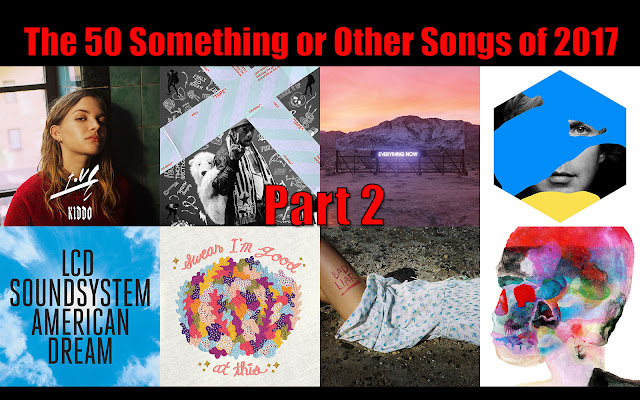
The 50 Something or Other Songs of 2017: Part 2

In our last exciting episode, I reviewed tracks 50 through 31 on Rolling Stone's list of the Best 50 Songs of 2017 . How did those ...