Showing posts with label Christopher Lee. Show all posts

Saturday, November 07, 2015

Recently Rated Movies: Catching Up with Christopher Lee (the actor, not my brother…) Pt. 7

After a solid month of Halloween-oriented posts, it is time to return to the regular departments on The Cinema 4 Pylon. This time, we have three more wildly diverse films featuring the late, great Christopher Lee, as I attempt to see as many titles in his filmography as possible. 

Sherlock Holmes and the Incident at Victoria Falls (1992)
Dir: Bill Corcoran
TC4P Rating: 5

Over 25 years after his first effort to portray the famed Sherlock Holmes on screen was basically squandered by a German movie studio, Christopher Lee got a second (and third) shot at wearing the deerstalker cap in a pair of films that played as television movies and then went straight to video. The first film, Sherlock Holmes and the Leading Lady, reintroduces Lee as the detective and Patrick Macnee as his Watson, both in their older years. Macnee was also getting another shot at his role after previously playing the good doctor in Sherlock Holmes in New York, opposite a fairly miscast Roger Moore.

In the second film in this pair, Holmes and Watson take to the Dark Continent under the orders of King Edward (Joss Ackland) to secure the Star of Africa diamond. On this adventure, they will end up cavorting with the likes of Theodore Roosevelt (a pretty good Claude Akins). The film makes an attempt at incorporating a storyline involving the making of the footage that Roosevelt shot on his journeys through Africa in the early days of cinema. Naturally, the diamond gets stolen, and as bodies start piling up, Holmes and Watson need to come to the rescue (with just a little bit of help of ol' Teddy himself).

While Lee and Macnee are pretty decent in their roles as the aging heroes, and Incident at Victoria Falls is nowhere near as bad as Lee's first Holmes attempt (1962's Sherlock Holmes and the Deadly Necklace, discussed briefly here), the direction by Bill Corcoran is fairly by the book and a little dull, and it is not surprising to learn that the series of films was stopped after this one. It's a shame they didn't attempt a regular TV series instead, with briefer episodes, so we might have gotten a little bit more of this combo and let them stretch into the roles a little bit. It's a shame we never got a good Holmes film with Lee in his prime, as he may have been terrific in the original stories. Sadly, we will never know for sure.


Mask of Murder (1985)
Dir: Arne Mattsson
TC4P Rating: 4

"Psychiatrists have already taken a good look at him, and they can't make up their minds whether his problem is in his head or his balls." - Chief Superintendent Jonathan Rich (Christopher Lee)

Some creep wearing a sack with holes cut in it and a lipstick mouth commits a series of grisly straight razor murders of female victims one day, but is soon trapped by the police, led by Christopher Lee and Rod Taylor. Holed up on a snowy farm, the killer injures Lee, but is shot to pieces and dies. And with his death goes the string of murders. Or does it? 

Mask of Murder is directed by Swedish film veteran Arne Mattsson, and was filmed in Uppsala, Sweden rather than the "small town in Canada - Nelson" it purports to be via a brief subtitle at the beginning of the film. If you are unaware (or don't care), Uppsala is the hometown of film giant Ingmar Bergman, though there is absolutely no relationship between his justly revered oeuvre and this cheap, savage film to have been made there. (A trivial note, and nothing more.)

The series of murders pick up again not long after, and the film goes to no real great lengths at all to hide who is behind them. I will leave that to the viewer to discover, but when you watch the film, there can be no other choice. In the meantime, we get a lot of relationship/adultery drama between Taylor and Valerie Perrine, who plays his wife. Perrine has the best role in the film, and while I am not really a fan of hers, I did enjoy her in this one. She and Lee seem to be the only ones really engaged in their roles.

Mask of Murder has some gory parts (and not really all that well turned) and it also features the requisite '80s softcore nudity and strip club scenes. The winter backdrop of the town is a nice change from most films of this type, and lends an extra layer of atmosphere, even if the actors need to wear an extra layer or two of clothing. The vibe in the murder scenes is a bit eerie, and from the opening sequence of murders we can tell this is not going to go the normal slasher movie route. But that doesn't mean it goes anywhere really remarkable either. It looks like a horror film, but actually gets bogged down in the sort of territory that you would have seen Andrew Stevens directing and starring in at the beginning of the '90s. (There is even cheesy synthesizer music playing over the love scenes.) If only Shannon Tweed would show up to make it all look a little nicer.


The Keeper (1976)
Dir: T.Y. Drake
TC4P Rating: 4

"Now, whatever you do, don't let him hypnotize you!"

The Keeper is by far the most interesting film of the three I am including in this post, and that is by a long shot. Let me warn you at the outset, it's not good -- in fact, it's the worst film of the three -- but also the most interesting and least dull of the lot.

Written and directed by T.Y. Drake (who used to perform on The Andy Williams Show as a Good Time Singer), this low-budget Canadian effort stars Christopher Lee as The Keeper, a mysterious figure who runs a mental institution in what we are told is British Columbia in 1947. There are half-hearted attempts to convince us that the film takes place 29 years before it was filmed: jazz on the soundtrack, a tough guy detective in a trenchcoat (believe it or not, the dick's name really is Dick, as in Richard "Dick" Driver), fast-paced tough guy talk, period cars, and most hilarious of all, a totally out-of-place shoeshine boy working on a mostly barren, leaf-strewn avenue who dispenses helpful advice (this kid seems to shine shoes all hours). But none of it works at all to take us out of whatever present we are in when we watch it.

Dick Driver is trying to get to the bottom of a mystery involving the wealthy patients being "kept" in the Keeper's asylum. "I'm only a custodial physician. Patients here call me the Keeper," insists the crippled, older man Lee portrays, but there is clearly something else at play here. His obsession with hypnotherapy may provide a clue, since he seems to be able to trick any visitors to the institution into being hypnotized before they leave. When visitors leave the institution, they seem to bite the dust, leaving large inheritances directly to their relatives inside the Keeper's institution.

And so we get wild, psychedelic scenes of never-ending spirals, flashing lights, and images of attacking dogs, spinning watches, and subliminal spiders, as the Keeper tries to control his subjects to his truly undisguised nefarious ends. Practically everyone in the film undergoes hypnosis at some point, and with everybody under his influence, it would take a major misstep for the Keeper to be brought down. Hmmm... I wonder what it will be?

We also get the bumbling interference of a police inspector, who besides getting tripped up by some mild slapstick, also gets hypnotized into thinking he is a choo-choo train, which is the most over-the-top sequence in the film (at least until the final shot of Lee at film's end). Though the actor (his name is unimportant) looks more like Harold Peary, who played the Great Gildersleeve, the police inspector kept reminding me of classic porn star John Leslie throughout the film. It was probably the weird mustache he wears that did it, as it is similar to the one that Leslie wore in a number of films. It's strange that I made this connection, because my mind created another link to '70s porn when I heard the private eye's name was Dick Driver. I could not help thinking that with a slight change in location, this script, inane as it is, could have been used in a Johnny Wadd film.

Now there's a job offer Christopher Lee probably would not have accepted in his very prolific decade of the 1970s.

Tuesday, October 13, 2015

The Resistance of Vision: Mr. Mulcahy and the Tale of the Mummy

Tale of the Mummy (1998)
Dir: Russell Mulcahy
TC4P Rating: 4/9


Not too long ago, there was a commercial for a Zack Snyder film where they proclaimed him as a "visionary" director. I took this to mean that he had the foresight to know he would get a chance to make at least another film (and, as it turns out, several films), and not as someone who had the ability to foresee incredible worlds and visions and have the drive and talent to make these worlds and visions come to life onscreen.

I have seen ads in recent years for other directors as well, where they use "visionary" as a come on to the public: Peter Jackson, Guillermo Del Toro, Terry Gilliam, Alfonso Cuarón, Alejandro González Iñárritu, and Robert Zemeckis. These guys are either fairly well established or incredibly so, and I don't want to argue who is or isn't here. I want to talk about applying such a term to a filmmaker too early in their career. If you had asked me back in the late 1980s for an example of a visionary filmmaker, after I finished raving about Sam Raimi, David Cronenberg, George Miller (the Mad Max one, not The Man from Snowy River one), George Romero, and David Lynch, I would have offered up this name: Russell Mulcahy.

I based the naming of Mulcahy at that time solely on two pieces of rather flimsy evidence: 1) Razorback, a wild hog horror film from 1984 that he made in his native Australia, and that I loved to pieces (saw it multiple times in a theatre in its brief run) even though all of my friends told me I was crazy (they tell me that about a lot of films, so I often wondered if they were the right friends for me); and 2) Highlander, that all of my friends that had previously told me I was crazy for loving Razorback also loved to pieces, as well as much of the Western world. Enough so that sequels were made, and a television show, and an animated series, and a spinoff of the television show, and even more sequels, and there continues to lurk the always rumored talk of a reboot movie. (I believe the most recent news is that Dave Bautista is set to play The Kurgan.)

Highlander hit me and my friends in a huge way, and I thought Russell Mulcahy was ah-ma-zing, even though a lot of the techniques he used -- super speedy cuts, blinding backlighting, tons of fog -- were things that I hated in music videos of that time, which is where he cut his teeth. More than cut his teeth, really; he made scores of some of the most famous music videos in MTV's heyday. Of course, an upbringing in a form where story is of little or no importance is often pretty apparent when you jump to the big screen, but with those first two films, I didn't care. Mulcahy was in my pantheon of godlike directors. 

And then, everything else on his resume happened. Yes, I have a small film-crush on a couple of his later films, namely Ricochet (1991) a goofy sci-fi thriller with Denzel in the lead, and The Shadow (with Alec Baldwin as that mind-clouding guy who knows what evil lurks, etc.), which they kind of screwed up but came so close to making a really fun movie. But he also directed The Real McCoyBlue Ice, and the appalling Highlander II: The Quickening, one of the worst sequels imaginable. Two things became apparent to me: that Mulcahy was really just a guy for hire flitting from job to job, studio to studio, and that he was nowhere near the "visionary" talent he had seemed to me a decade earlier. Also, looking up Tale of the Mummy on IMDb after watching it, I came to the realization that I had only seen one Russell Mulcahy helmer since The Shadow in 1994. That was 2007's Resident Evil: Extinction, the third in that series, which I only found moderately watchable. 

So, Mulcahy had really fallen off my radar, and in fact, I was surprised to see his name in the title of this film when I ran into it on Netflix while trying to track down any number of lesser films on my Christopher Lee watchlist. Yes, that's right... the late Christopher Lee appears for a few minutes in Tale of the Mummy, which in itself makes it a must see owing to his having played The Mummy early in his Hammer career (1959). You don't need to go very far to see the breadth of his role. He sets up the story at the tail end of the 1940s by finding the tomb of an ancient deviant/mummy named Talos, thereby releasing the moldy creep's curse, which results in the horrid death by surprisingly poor special effects of Lee's character and his compatriots. (The part where Lee crawls across the film with the lower half of his body missing is a true howler of a scene.)

Fifty years later, Lee's granddaughter, Samantha (played by cute Louise Lombard) endeavors to follow in his footsteps, except hopefully without that whole "dying due to a mummy's curse" thing. She comes out of the expedition unharmed, but a couple of other members are not so lucky. A baby-faced Gerard Butler plays a truly idiotic researcher who gets a little too greedy, and Sean Pertwee (currently Alfred on Gotham, and pretty fun in this flick) plays a team member who goes more than a little batty with visions brought on by his exposure to the tombs. (Pertwee's character is, I guess, the visionary that Mulcahy never was?) 

Months later, back in London, the death of a U.S. senator has Riley, an American detective (Jason Scott Lee) paired with Bartone, a British one (Jack Davenport), and their investigation revolves around a exhibit at the British Museum displaying the finds from the Talos dig. They eventually figure out the connection to Lombard and Pertwee, while more mysterious murders continue to occur in London (though the film was chiefly filmed in Luxembourg). 

The murders are not so mysterious to we viewers, because we get to see nearly every one of them in glorious, low-budget, hack-handed CGI. The film has the look and feel of a fairly decent Hammer-style tribute (think Curse of the Mummy's Tomb as an example), except for when the ludicrous effects kick into gear. The bulk of them involve flying (or crawling on the ceiling and walls) mummy wrappings that attack the victims and remove them of a single, particular body part (starting with the senator's eyeballs). It is clear Talos is building a new body so he can be resurrected and unite with his spirit to run amok in the world again. As his collection of parts grows, we get to see more and more of the wrappings begin to coalesce into a solid form with each attack. However, most of the time it looks like people being assaulted by dirty linens, and not very believable linens at that.

The film actually looks pretty nice, and has many of Mulcahy's standard lighting effects (especially in the gay nightclub and tomb sequences). Most alluring is a cast that has too many recognizable names to just be ignored. Apart from the several already mentioned above, Lysette Anthony, Michael Lerner, Honor Blackman, Jon Polito, and Shelley Duvall are also to be found mucking about in the plot, and I enjoyed their contributions to a film generally beneath their respective talents. (Old school punker Edward "Eddie Tenpole" Tudor-Pole shows up briefly as well.) I can forget that the plot makes little sense at all, if the actors commit to even the smallest roles and make the trip as enjoyable as possible for the viewer.

But despite how the film looks and how the cast acquits itself, the film is just overridden by those special effects sequences. Too prevalent to ignore, especially since the transitions from plot point to plot point hinge on them, they sincerely made me wish that Mulcahy would go back to the film, drop some new coin on some decent special effects work, and edit them into Tale of the Mummy. We would ask, "But why did you spend all of this money after so many years to redo your film?" All he would have to say is "I didn't have the budget at the time, but I knew -- twenty years later -- I would make things right and show the world my masterpiece! Myah-hah-hah!!" 

And then we would know he was a true visionary. A crackpot, yes... but a visionary all along.

Monday, October 05, 2015

Return of the Son of Terrible Movies Promo Blowout! [Pt. 1]

In the beginning there was The World's Most Terrible Movies...


If you lived in Anchorage, Alaska and its environs in the 1970s and liked to stay up super late on Saturday nights, then you might remember the above clip. You also may well remember The World's Most Terrible Movies (and its spinoff, Son of Terrible Movies) which ran late nights on weekends on Anchorage, Alaska's ABC affiliate, KIMO-TV (Channel 13) in the 1970s.

The clip above is one of the opening segments used for the show, which ran older horror and sci-fi films, including many Hammer horror classics and Ray Harryhausen adventures, when I was a teenager. While I had many influences in my youth, The World's Most Terrible Movies is probably the #1 reason I became a fan of fantastic films of all types. [To learn more about the show and how I obtained these clips, click here.]


My interest in fantastic films was already apparent when I was relatively young, but seeing those Hammer and Harryhausen flicks on Saturday evenings blew it up huge for me. The World's Most Terrible Movies is where I met Christopher Lee's Dracula, Frankenstein's Monster, and Fu Manchu, where I first watch cowboys attempt to snare Gwangi in their lassoes, where I saw Sinbad and Jason fight animated skeletons, and where I learned who Peter Cushing, Barbara Steele, and Paul Naschy were. Most importantly, it's also where I fell head over heels for Raquel Welch in a fur bikini.


I guess we all have those moments in our youth where the mind expands after we have discovered something that perhaps we probably shouldn't have. For some people, that might be drugs, alcohol, or adolescent sexual stirrings that get taken farther than they should at the time. And for some of us, we find the cinema of the bizarre, of cult directors, under-appreciated actors, and twisted genres. I think we are the smarter and luckier group.


Vampires, giant monsters, wolfmen, robots, go-go girls, mad scientists... they act interchangeably as our priests and our demons. Movies move far beyond a mere entertainment for our kind. We recognize early on that, when the rest of the world denies us, the movie theatre is where we can go to submerse ourselves in other worlds for comfort. (But not guidance... no, that is probably not the wisest thing.) And once we have walked through those doors, we can't go back. The mind changes immeasurably. Things cannot be unseen. Or as Pauline Kael put it, "I lost it at the movies."


More than anything, movie showcases like The World's Most Terrible Movies held open those doors for me. And I have never gone back, nor have I tried. And through horrid jobs, a bad first marriage, moves across the country, and frustration at nearly every turn in my life (like all of us have), I know that I can make the pain go away by the simple push of a button or the purchase of a ticket. And when I hear the sounds of the opening fanfare that announce the film is starting, I might just as well be back in my living room in the pitch darkness at age 12, covering every inch of my body with a giant blanket except a small slit in front of my eyes through which I can watch the television screen, waiting for The World's Most Terrible Movies to begin.


To be continued later this month...

Wednesday, September 30, 2015

Recently Rated Movies: Catching Up with Christopher Lee (the actor, not my brother…) Pt. 6

The Resident (2011)
Dir: Antti Jokinen
TC4P Rating: 5

I know Hilary Swank likes to work, but why The Resident? Isn't there something more noble she could do with her time? Isn't there a stern, hardheaded frontierswoman that needs to be portrayed somewhere? Yeah, I know she started out in the original film version of Buffy, but you just don't think of her in this genre. Not that it is a bad thing to have her in something horror-oriented, but I cannot imagine what would have attracted her to the job except a sizable paycheck. 

The Resident is product, cut and dried. Mostly dried, because it is as rote and numb as a stalker film can be. From its case, to its DVD label, to its trailer, to its DVD menu. Every move telegraphed, every camera angle expected, every emotion cut out with the rest of the cookies. The poster I show at the right has one big head (Swank's), and I chose this one over the other one with two big heads (Swank's and co-star Jeffrey Dean Morgan, who is fairly effective as her sweaty lover/antagonist). I did this to downplay to you, the reader, that you are going to look at a review about an edit-by-numbers feature, otherwise you might not stop by. Two heads: Too obvious. Must automatically be a dull, shitty movie. One head: Mmmm, maybe there is something more to this... nope, dull, shitty movie.

Christopher Lee's part in The Resident is the best thing in the film. He gets to be pretty creepy as Morgan's truly terrible, haranguing grandfather. It is not a surprise that something awful will happen to him eventually. Maybe working with Lee was the reason Swank did the film, but I am going to doubt she really knew much about him. Maybe working with the resurgent Hammer Studios was an attraction? I doubt that too, though they may have thrown some money her way to get a big name star for one of their comeback features. I just it would have been for something more fun-sounding like, say, Amelia Earhart: Gremlin Hunter.


Dark Places (1973)
Dir: Don Sharp
TC4P Rating: 5

An interesting thing (well, I find it interesting) happened to me while I was preparing my capsule for Dark Places, a typically well-mannered British horror film from the mid-1970s. I had worked up the first two paragraphs of what I thought was a solid short review, when I changed my mind. The cranial swerve engaged because, in the middle of the third paragraph, I went back to watch a couple of sections of the film a second time, as I wanted to make sure I had some details correct in my head. It struck me quite suddenly that this was the not the film that I was writing about earlier. Yes, it was the same film, but perhaps due to being tired or bored with the thing at the time I first viewed it, I had somehow burned the wrong remembrance of it into my brain. I also blame the several days delay between the viewing and the writing of the review. Thus, I ended up backtracking and watching the entire thing again.

In my original version, I was firm on the point that my chief problem with the film was the dual lead performance of veteran character actor, Robert Hardy. I had worked up details on my early exposure to him as Siegfried Farnon on All Creatures Great and Small in my teenage years, and how I have indeed enjoyed him in numerous parts ever since. And then I declared that despite the fact that I did like him, Hardy often comes off as too stagy for me. I reasoned that perhaps when the part was cheesy enough, he felt the need to serve a little extra ham with it, in a way that you could often get away with it on the boards, but rarely without notice on the screen.

But on the second watch, I settled into his performance, and I realized that the fault was mine entirely. Hardy was playing it as he needed to and I was the one who was approaching it with a jaundiced and incorrect viewpoint. I suddenly noticed that he actually introduced some nice subtle character differences between the psychological breakdown his main character is experiencing in the film and the raving, murderous lunacy off his secondary role. Because of my haste in getting through the film, I almost missed what is actually a decent performance.

Outside of this, the story is not particularly thrilling (heir to an estate returns home while various vultures roam about trying to locate some lost suitcases full of cash), but Dark Places has a bit of spookiness at play in its isolated country estate main setting, and it is chockablock with the sort of actors who generally make these sort of affairs so enjoyable; chiefly, notable British ones. Christopher Lee and Joan Collins (both at home here) are a kinky pair of scheming siblings who are trying to locate the money, as is the dependable Herbert Lom, downplaying his notorious scene-swiping and coming off very effectively. Jane Birkin is lovely in a small, undemanding role. Finally, a favorite of mine from childhood, Jean Marsh, gets to engage in some fantastic histrionics while she displays, in separate scenes, precisely how not to clear a large dining table and how not to keep your husband’s attentions from straying in the bedroom.

As for the horror bits, they are for the most part a little too understated for my tastes, but there is at least one good bloody reveal that works well, and there is a pretty memorable pickaxe scene that I enjoyed even more on the second go. And if you want to annoy me to Hades, add little giggling towheaded brats to your cast, and then punctuate their appearance by employing their disembodied giggles and voices on the soundtrack as added torment. I will wish the worst murder on them from the second they appear on the screen. (Just don’t renege on the promise of this.)

I am not afraid to switch directions on a review, or reverse my opinion altogether if I see a movie anew and leave the screen with a different take on it. But, even after my turnabout on Hardy’s performance, this was the first time that I was thinking noticeably different about a film but still came away wanting to give it the same exact rating as I had planned to give it. While there is much to recommend within the frames of Dark Places, I just couldn’t come around to moving it up to my “generally good” rating (a "6"). It has all that stuff you like in British horror from the 1970s, except that the results are more middling than anything. But I did end up accepting Robert Hardy in it.


Too Hot to Handle (1960) [aka Playgirl After Dark]
Dir: Terence Young
TC4P Rating: 5

I am not a Jayne Mansfield fan. As far as potentially unhealthy obsessions with dead blonde movie stars from the ‘50s go, I am solidly in the Marilyn Monroe camp. (And I actually got over her a good while ago.) But with Jayne, I find little about her that fascinates me. She has her defenders (every “star" does) and I am totally fine with that. She just has never done it for me. I have always seen her more as a gimmick than an actress. Director Frank Tashlin knew just how to walk that line with her, employing her talents effectively in The Girl Can’t Help It and Will Success Spoil Rock Hunter?, films that are in my personal canon.

Jayne has the lead role in Playgirl After Dark, which can be found online in various places as Too Hot to Handle, but the film is not really about her. It’s a tough little British gangster pic, and the plot revolves chiefly around a “key” club owner, Johnny Solo (yeah, that’s his name), in London who runs afoul of another club owner, and decides to fight back against the protection racket. Mansfield plays his stripper/performer girlfriend named Midnight Franklin, and Jayne gets several opportunities onstage during the film to let the girls breathe.

In the mix is the real reason I watched this film, Christopher Lee, as Johnny Solo’s duplicitous right hand thug, Novak. It’s a small role, but Lee’s presence adds a lot to the film. Also here is Barbara Windsor as a newly hired blonde stripper named Pony Tail. She is also a tad bit underage, so I wonder if that will add anything to the plot? Oops! I recently got to see the chipper Windsor in a couple of Carry On films (her inclusion here and her inclusion there will tell you something of her looks) on TCM, so it was a pleasant surprise to see her show up in this.

Playgirl After Dark is a bit too monotonously talky for a gangster flick, and it is not particularly well-filmed. That said, for a low-budget crime piece, it does move along well, the plot is fairly engaging, and the stage performances and the OK songs break things up nicely. I prefer some of the other performers to Jayne, but that is just me. Must be the non-fan in me.

Monday, September 28, 2015

Recently Rated Movies: Catching Up with Christopher Lee (the actor, not my brother…) Pt. 5

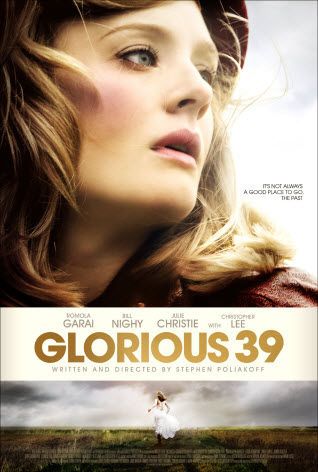
Glorious 39 (2009)
Dir: Stephen Poliakoff
TC4P Rating: 6

Without doing much in the way of research, I don't know how far Britain's pro-appeasement movement went to protect their position during the rise of Nazism in Europe, but murdering opposing Parliament members and making them to appear suicides? I suppose if the movement were actually a front to eventually allow Hitler to have his way, then sure, I'd buy it. I'm not sure if that is what Glorious 39 is selling, as the majority of pro-appeasement figures seem to believe, like PM Neville Chamberlain, that such an approach is the only way to keep the Nazis from running roughshod over England. It doesn't seem like the sort of thing to call for the very noticeable and mysterious deaths of leading citizens.

Glorious 39 is about a true loss of innocence, as the idyllic country life of its lead character Anne (known as Glorious to her family, and played appealingly by Romola Garai) comes crashing down when she discovers pro-appeasement 78 rpm recordings stored in her family's estate. Is Anne just paranoid? Is she losing her mind? Does she simply need a lie down? All of this is suggested to Anne, and she will learn quickly that no one is to be trusted in her family and friends. 

The film is told in flashback through a bookend apparatus where we meet two of the family members played in old age by Christopher Lee and Corin Redgrave. The story they unfold reveals family skeletons long dormant since the lead character's disappearance in 1939. I like some of the details, like the "fat men dancing," revealed in spending time with what appears to be a happy family situation. There is a remarkable section where one begins to see the thin line that rests between order and chaos in the era, where the slightest changes can erode personal freedoms and leave their fates to history. Rest assured, I doubt my next visit to the veterinarian will happen without flashing back on the horrific chain of events that occur when Anne is made by her father to take her family's cats in to be euthanized (as is, according to the film, the fashion amongst the upper crust during that time of uncertainty).

It's a solid effort, though a bit dull at times, and easily goes on about twenty minutes longer than it needs to be. For those for whom all-star casts are a nod of quality, the film is top-loaded with British favorites: Bill Nighy, Julie Christie, Jenny Agutter, Jeremy Northam, a young Eddie Redmayne, an even younger Juno Temple, Charlie Cox (the current Daredevil), Hugh Bonneville, and the Tenth Doctor himself, David Tennant in a small but important role. Now, if only Tennant had dropped into the film in his legendary Tardis, Glorious 39 might be a far more exciting picture. Then I wouldn't have worried about historical accuracy.


Meatcleaver Massacre (1977) [aka The Hollywood Meatcleaver Massacre]
Dir: Evan Lee
TC4P Rating: 2

Christopher Lee's career definitely seems to speak of poor management, at least for large portions of it. For every big role in a major film or getting some of that sweet franchise cash, there seem to be five or six projects where he surely must not have either cared about the results or was duped into appearing in it. In Meatcleaver Massacre, the rumor is that he was told he was recording the narrative introduction and epilogue for one project, which was then implanted onto this supernatural, would-be thriller. His odd and, frankly, not particularly adept narration has not the slightest thing to do with the film at hand, but it does add a touch of Ed Woodiness to the finished product.

And by Ed Woodiness, I mean possible, actual Edward D. Wood, Jr. While rumors all over the internet about his involvement have ranged from appearing in the film (he is in the credits on IMDb in a bit part, but it could be just another Ed Wood) to writing the script to directing it under a pseudonym, according to Andrew Rausch's book Trash Cinema: A Celebration of Overlooked Masterpieces, a source from the set says that the actual Wood not only appeared in it along with other crew members, but also stepped in to direct a handful of scenes. Regardless of his input or even existence on the set, this is an appropriately shabby affair fit to rest alongside much of his oeuvre. The filmmakers were at least channeling his abilities when they threw this decrepit pool of cess together.

While there is the massacre of a family early in the film that sets up the rest of this mess, there is not a meat cleaver to be found (the killers, or at least a couple of them, only use butcher knives). The killers are supposed to be college students, but appear to be in their late thirties, and there is a serious hippie look to them, probably playing off the Manson vibe so prevalent in '70s films. (The film has a 1977 copyright, but was likely filmed several years earlier.) The father of the family, a professor, left in a coma in the hospital, somehow uses supernatural powers to get his bloody revenge on the killers, one by one.

Because the print is in such terrible shape, this film is not only a labor to watch all the way through but to even look at for five minutes. It's almost like watching a feature shot on PixelVision, except this film has some of the most nauseating color I have seen. (Fisher-Price's wonderful PixelVision camcorder only shot in black and white.) 

In fact, from start to finish, this film gave me an uneasy feeling, and I did suffer a huge headache while watching it. Perhaps it was the film or just my general health. Supposedly, the producers came up with the title Meatcleaver Massacre as a surefire way to grab an audience. I guess Out of Focus, Garishly Colored Cinematography Massacre was not as much of a grabber, but it may have been more truthful.


Triage (2009)
Dir: Danis Tanovic
TC4P Rating: 6

Apart from surviving employment with Cal South for a decade, I cannot speak with surety about post-traumatic stress disorder. And while I just made a joke involving it (but not about it), I don't find PTSD a laughing matter. Far too many people are affected by it, not just those returning from combat situations (PTSD is not exclusive to soldiers), but also their families, friends, co-workers, neighbors... anyone who knows someone that has it can also suffer the repercussions of the disorder.

To be sure, Triage doesn't play anything for laughs. It may be one of the more dour films I have seen in recent years, making Melancholia seem like a joyride. (Well, for me, Melancholia was a joyride, my favorite film of 2011.) Colin Farrell's character in Triage is a war photographer who returns from a combat zone in the Middle East with a big secret. Where is his best friend David, a fellow photog and expectant father who accompanied him to the region? Why have Farrell's emotions seemed to shut down since his return and why is he reluctant to talk about his war experiences?

Farrell is solid, but even better are Paz Vega as his wife and Kelly Reilly as his best friend's pregnant spouse. And this may be one of the best latter-day, non-Tolkien Christopher Lee performances, as he essays the role of Vega's grandfather, a therapist who at one time controversially counseled some of Franco's war criminals from the Spanish Civil War. Vega's character continues to take issue with her grandfather on the subject, but knows that he may be the key to unlocking the mystery in Farrell's head. It was an angle I was not expecting while watching Triage, and I found the film all the more interesting for its inclusion.

It's worth a look to anyone interested in the subject, though I feel, despite the relatively short length, Triage suffers a bit from pacing issues. I have been remiss in watching Bosnian director Danis Tanović's Oscar-winning feature, No Man's Land, having started it thrice and never getting more than a few minutes into it. (This was due to a series of interruptions in my life, not because of the movie itself.) Given my look at Triage, I definitely need to get back around to watching No Man's Land

Saturday, September 26, 2015

Recently Rated Movies: Catching Up with Christopher Lee (the actor, not my brother…) Pt. 4

Safari 3000 (1982)
Dir: Harry Hurwitz
TC4P Rating: 3

My first true experience with the car racing madness which gripped the entertainment world in the mid-to-late ‘70s was getting to see The Gumball Rally in a school gym. (This is not to discount my youthful love of Wacky Races in any way, but that was a previous iteration of the same madness.) I don’t remember the context of why we were allowed to see the film, but just that it made its way to our school and my friends and I all got a much needed break watching what we thought then was a hilarious film. (Honestly, it could have been The Diary of Anne Frank, and we still would have had a good, riotous time, as long as we got out of class.) I have heard from others in the Anchorage area who were around my age at that time that Rally played at their schools, so perhaps some enterprising exhibitor decided that if the kids weren't going to come to the movie theatre, bring the movie theatre to them. Regardless, Rally brings back memories of those days just before the home video crazy hit our household, when I had to take in every film I could when given the opportunity. Even an average film like Rally was cherished dearly for what it represented to me at the time. [Don't get me started on Won Ton Ton, the Dog Who Saved Hollywood.]

Safari 3000 is not even close to The Gumball Rally. Safari 3000 is a film that is more directly tied in influence to the wild Hollywood success in 1981 of The Cannonball Run, the Burt Reynolds starrer which used as its inspiration the same real life transcontinental race that begat The Gumball Rally and another film from 1976, Paul Bartel's Cannonball. Safari 3000 is also about a drastically elongated race, this time across Africa, and goes for an even broader comic style than the Reynolds film (itself barely reigning it in at all). The difference is that The Cannonball Run gave us numerous, clearly delineated teams and took the time to... I wouldn't say develop the characters, but did give many well-known (Dean Martin, Sammy Davis, Jr., Roger Moore, Jamie Farr) and soon to be well-known (Jackie Chan) comics and actors the time to do their respective schticks. Safari 3000's budget is much lower, and as such, while it is sometimes certain that teams from several countries are taking part in the event, only two teams -- that of the good guys (David Carradine and Stockard Channing) and the baddies (Christopher Lee and Hamilton Camp) -- are really given anything substantial to do in terms of the film's plot or even at least seem like they have a chance of winning the race.

Because of this, there is another obvious influence for this film: Blake Edwards' The Great Race (1965), one of my personal favorites. The relationship between Christopher Lee's character -- the flamboyant, Darth Vader-style helmet-wearing Count Borgia -- and his buffoonish henchman, Feodor (played with utter annoyance by Hamilton Camp) fully reminds one of Jack Lemmon's Professor Fate and Peter Falk's Max from The Great Race, except that Max could be counted on in times of crisis (the castle escape) and was really less of a klutz than Fate. I said Camp is annoying, but he does provide the one moment where I genuinely smiled during the movie, and that was the song he sings in one of Safari 3000's better moments, Baboons on the Road. I may have been smiling chiefly because it reminded me of Leona Anderson's execrably wonderful Rats in My Room (please look it up), but I smiled nonetheless. 

Also, just as the hero and heroine in the Edwards' film played it, Carradine and Channing do the "diametrically opposed partners who are obviously smitten with each other" routine as they bicker endlessly and struggle to get past whatever hijinks Lee and Camp lay in their path, and the film likewise struggles to convince the viewer it is all supposed to be a lot of fun. As for the car action, I got very little enjoyment out of the rally scenes, and never really believed any of these racers (even Carradine) could win such a race, let alone drive this film out of the mud in which it is clearly mired. And I'm not sure seeing this film in a school gym at the age of twelve would have helped me enjoy Safari 3000 any more either.


Eve (1968) [aka The Face of Eve]
Dir: Robert Lynn & Jeremy Summers
TC4P Rating: 4

I was only able to find a YouTube version of this jungle girl picture (cut into several small sections), which is sad because if I am going to spend 96 minutes wandering about a jungle with Celeste Yarnall in her skivvies, I would like to do so with a print that is not nearly as desaturated of color as this one was. Regardless, film watching on my behalf did commence, and if I squinted enough, I was able to enjoy the charms of the pulchritudinous Ms. Yarnall as long as they didn't include actual acting.

Due to my upbringing as an Edgar Rice Burroughs fanatic, I have little resistance to jungle pictures, and Eve is not as dull and cheap as many I have seen. It is certainly faint praise, because neither does this hack itself out of the thicket to crawl onto the heap of the slightly good. 

The cast is decent enough. Once again working under producer Harry Alan Towers and co-director Jeremy Summers, Christopher Lee portrays the title character's grandfather, who is having a long con pulled on him by his supposed friend, played by the reliably villainous Herbert Lom, and is unaware that the girl he believes is his lost granddaughter is an imposter. Steady Fred Clark plays a greedy saloon owner who wants to cash in on Eve's fame, even though he already has Maria Rohm (Towers' real life bride) as his songbird in keeping. And Robert Walker, Jr., who astounds me by how much exactly he looks like his more famous father, is merely OK in the hero's role.

I wish that I was able to see a better print of this film, though I doubt it would make it more exciting. It's workmanlike and inoffensive enough for a matinee visit, but there is nothing special to be discovered in this jungle.


Five Golden Dragons (1967)
Dir: Jeremy Summers
TC4P Rating: 4

I am not really a Bob Cummings fan. I found him pleasant enough in some films from the 1940s such as Hitchcock's Saboteur, The Devil in Miss Jones, Moon Over MiamiKings Row, etc. (I will admit I have never seen any of his early television work, for which he was nominated for several Emmys, winning one). But his light, mannered style doesn't always work for me, and I often feel he is miscast. (I still feel he is miscast in Saboteur, but the film works regardless.) Here he is 25 years later, still doing his light comedy schtick as the lead in the Bond/Hitchcock pastiche, Five Golden Dragons, yet another Harry Alan Towers/Jeremy Summers collaboration.

Christopher Lee is here again too, as one of the titular Dragons, but he only appears in this film fleetingly, and only when he is with three of the other Dragons, played by three other older film icons, George Raft, Brian Donlevy, and Dan Duryea. The Dragons are international businessmen who have formed a cabal intent on taking over the world's economy, and use Hong Kong as their base of evil. If you want to know the full extent of what these four renowned film stars do in this film, it goes in this order: 1) enter room wearing a cartoonish dragon mask and robe, 2) sit down, 3) put key in lock in center of table and hope that a gun doesn't shoot them, and 4) take off cartoonish dragon mask and discuss business. The four Dragons do this three times in the film, and nothing more, exciting for some varied emoting and eyebrow arching. Must be nice to get a paycheck.

Cummings' character is a middle-aged playboy who ends up smack in the middle of the 
Dragons' plans (and who knows... might even be the fifth Dragon?). He gets all the fun in the picture, being surrounded, toyed with, tortured, and teased by the likes of the omnipresent Maria Rohm, Maria Perschy, and Margaret Lee. Klaus Kinski is there too as the main toady for the Dragons, though he gets to do little but look exactly like Klaus Kinski (which is evil enough for some).

I am tempted to rate this film slightly higher because I actually did have a lot of fun watching small chunks of it. Five Golden Dragons looks gorgeous, chiefly because of the eye candy, but also for the Hong Kong locale. If you are looking for a groovy '60s flick for a party, this one might work, especially for the costumes and the swingin' nightclub scenes (of which there are several). But the movie itself is just really dopey, the whole Dragon angle fizzles completely as something on which to hang a plot, and any dialogue not involving good guy Bob talking to one of the female characters is strictly dullsville. 


As for Bob, he acquits himself well in what I believe was his last feature film role, and knows he is in a piece of dreck from the start, saying everything with his tongue as deep in his still handsome cheek as it would go. He was still miscast for the part (by about a chunk of twenty years), but at least he hit his marks and delivered his lines... with a knowing wink.

Monday, September 21, 2015

Recently Rated Movies: Catching Up with Christopher Lee (the actor AND my brother…) Pt. 3

Here is another round of capsule reviews for several of the Christopher Lee films I have been pounding down for the last couple of weeks. 

An interesting note: While I was in the midst of finishing up the first segment of this series, I received a phone call from my youngest brother, whose first and middle names are also Christopher Lee. I had titled this series "Catching Up with..." and then appended the title with "(the actor, not my brother)," but now I had literally caught up with A Christopher Lee. 

Yes, I didn't post the first two parts of this series until after I talked to him, but I decided to keep things in the order in which they were created, and that includes changing the title this time to reflect that very necessary contact. Regardless, it was so good to hear from him after over a year of radio silence, and I won't allow time to pass like that again.

And now, more capsule reviews of some smaller C. Lee flicks, and I must say that it is a very diverse mix of genres this time...

Sherlock Holmes and the Deadly Necklace (1962) [Sherlock Holmes und das Halsband des Todes]
Dir: Terence Fisher
TC4P Rating: 4

An extreme disappointment, given that the very idea of seeing Christopher Lee filming a Sherlock Holmes film just a couple of years after his part as Sir Henry Baskerville in a Hammer production is immensely appealing. But his wonderful voice is dubbed over in this film, as are all of the actors (including Thorley Walters as Dr. Watson), and so the world would have to wait many, many years to hear Lee actually produce sounds out of the mouth of literature's most famous detective.

Also adding to the disappointment is learning that the rather staid direction is done by none other than Terence Fisher, who was at the helm of all those early Hammer horror hits for Lee, including The Hound of the Baskervilles. What a difference four years and filming in Germany instead of Britain can make.

The film itself is not so much a coherent mystery as it is several small set pieces that never jell together. Apart from Lee, who at least shows that he is working hard and displays abundant energy in his role, the film comes off rather dull and uninteresting, and when added to my stated disappointment that one will not get to hear Lee as Holmes at all, lessens the effect of the film even more. Oh well, at least the sets look swell.


End of the World (1977)
Dir: John Hayes
TC4P Rating: 3

How many films do you know that start off with a public payphone exploding in front of a desperate priest played by Christopher Lee, followed by a coffee shop owner getting scalding by an exploding coffee machine and then electrocuted by a neon sign as he blindly crashes through the window at the front of his shop? And then Lee meets what appears to be his doppelgänger, who welcomes him home? It’s probably a very slim genre, comprised of just this poorly produced (by none other than Charles Band, creator of Laserblast and father of the Full Moon studio) and far too dark, alien invasion flick.

The film is stocked with Ed Wood-level character motivations and dialogue, which in itself would make this seem to be a must-watch for “bad movie” enthusiasts, a contention with which I will agree. Looking at a shopping list of the elements of this film — coded messages from space warning of massive natural disasters, aliens disguised as nuns, a host of well-known character actors (MacDonald Carey, Dean Jagger, Lew Ayres, Sue “Lolita” Lyon, and the aforementioned Lee) — one would think that at the very least you are going to be in for some good, cheap thrills. And how wrong you would be.

Director John Hayes, working since the early ‘60s, would end up his career for the most part making X-rated films under a pseudonym, but I am certain those were far better lit than this film, which seems to mistake a pitch black screen for large portions of the running time as “suspenseful”. When the lead character, a scientist, is harangued again and again by his superior to get back on his speaking tour, then you realize it is not the most exciting setting for science fiction fun. And when one finishes watching a film and the chief image one takes away from it is that of the same scientist sitting endlessly in a room full of archaic computers while the nonstop clacking of a computer keyboard is heard on the soundtrack, then saying the film is bereft of real action is a true understatement.


Jaguar Lives! (1979)
Dir: Ernest Pintoff
TC4P Rating: 5

I must admit that I knew nothing of the star of Jaguar Lives! — kickboxing champion Joe Lewis — going into watching the film. I have yet to see his other big film, Force: Five (1981), and I was also not aware that he was apparently the first choice to play the villain role taken memorably by Chuck Norris in Bruce Lee’s The Way of the Dragon, in the famous fight finale in the Roman Colosseum. Possibly things may have gone another way for Lewis’ Hollywood career had he not lost the part, but it is hard to tell. He is about as wooden an actor as Norris was at that same point in time, though I think Lewis is certainly better-looking. (And now ol' Chuck is going to kick me in the face for that...)

Jaguar Lives! is filmed quite well (for the most part), and veteran director Ernest Pintoff keeps things tight and moving from scene to scene in a film quite obviously meant to be a James Bond pastiche. This a case where having a large cast of famous character actors works to the film’s definite advantage. Apart from Woody Strode (as Lewis’ taciturn sensei), John Huston, and Capucine, the film has been stocked to the rafters with actors who have previous experience toying around in the Bond series: Christopher Lee (The Man with the Golden Gun), Donald Pleasence (You Only Live Twice), Joseph Wiseman (Dr. No), and Barbara Bach (The Spy Who Loved Me).

Lewis’ secret agent character, Jonathan Cross aka Jaguar, zips around the world meeting several seemingly villainous characters who might have some information that will help him figure out who is behind an international drug cartel that tried to have him killed. I assume the intent of the Bond connections is to keep the viewer guessing who the Big Bad is behind the plot’s machinations, but it is pretty easy to figure it out. Each stop about the globe also presents Lewis with an action scenario from which he must use his formidable martial arts skills to extricate himself. As long as you are willing to swing along with the episodic format and don’t suffer from a need for any sort of emotional depth from a film, Jaguar Lives! can be a pleasant little time-waster, but nothing more.


Penny and the Pownall Case (1948)
Dir: Slim Hand
TC4P Rating: 5

Once upon a time there was a British comic strip in The Daily Mirror named Jane, which featured the title character, Jane Gay, in various misadventures where she would inevitably get stripped down to her undies (and eventually, in 1943, down to even less). It was exceedingly popular in the UK and with soldiers, kindled American strips which were far tamer, was subsequently distributed and rejected in America, and inspired stage, television and screen versions throughout the decades. (Does anyone remember Jane and the Lost City from 1987? I do.)

The British-made Penny and the Pownall Case is not a version of Jane, but it does revolve around a comic strip exactly like Jane. The lead character is a comic artist’s model who ends up getting sucked into a plot involving Nazi war criminals. She also tends to get undressed here and there, but it is all done rather innocently, and there is nothing truly prurient about the film. Lead actress Peggy Evans seems to be having a lot of fun in the role, as her character manages to keep unsullied as she teams up with a detective to stop the bad guys. One of those bad guys, Christopher Lee, is only 25 or 26 years old in this, but he is already a magnetic screen presence. (Having that voice helps…)

Penny is barely of feature film length — only around 44 minutes — and is practically over before you realize it. In fact, I had to research whether it was an early television film before I watched it. The plot is predictable but quick, there are some good farcical bits involving an adjoining hotel suite, and the comic strip trappings add a welcome twist of novelty to what could be just another Nazi potboiler. But it needs a bit more, because it doesn’t come off as nourishing entertainment overall. Maybe if it was stretched out for another 15-20 minutes with a bit more character development, Penny and the Pownall Case could have been something more than just standard.

Thursday, September 17, 2015

Recently Rated Movies: Catching Up with Christopher Lee (the actor, not my brother…) Pt. 2

Of the Christopher Lee films I have seen to this point, the one area in which I hardly need delve are his most famous and popular roles. It has been decades since I first saw his Hammer Draculas and his turn as Frankenstein’s Monster, his villainous appearances in Bond and Three Musketeers films, and his Fu Manchu series countless times, and every role is etched in my memory. His later appearances in major modern epic series (LOTR, Star Wars) are also to be counted in this group, even if I hold little fondness for the last three Star Wars entries. I have also seen many of his supporting roles in films such as Serial (1980, of which I am still fond), a variety of turns alongside his old chum Peter Cushing in non-Hammer horror flicks, and his odd cameo in The Magic Christian (as a vampire waiter on an ocean liner). 

The point is that I am already well-versed in his major roles. In reviewing his oeuvre over the past couple of weeks and recalling his movies that I have actually seen to this point, there have been few thus far (except for some of the horror ones and The Magic Christian, which is certainly memorable but actually not very good) that I would describe as resting near even the lower rungs of the higher echelon of filmmaking.

But, as I make my way through his unseen flicks, I am discovering that there are plenty of near misses. As I recounted the other day, Hannie Caulder turned out to be a pretty good revenge western, if not great. Then I ran into three films which are ever so close to being good solid films, but just narrowly miss the mark for me. I am fairly certain that if I saw any of these three as a teenager or young adult, they would probably rank higher up in my memory, but I only just saw them in the past week. All three warrant follow-up viewings, and I will leave it to those moments to determine whether they move up or down in my rankings. So while I currently have assigned all three my middle of the road “5” rating, they were all worthy of my time and eventual, almost assured revisitation.


The Torture Chamber of Dr. Sadism (1967) [aka The Snake Pit and the Pendulum; Torture Chamber; Castle of the Walking Dead; Blood of the Virgins; The Blood Demon; and many, many more…]
Dir: Harald Reinl
TC4P Rating: 5

One of the first hurdles for any horror film is evoking and maintaining a haunting atmosphere. This film has atmosphere in spades, as long as the soundtrack doesn’t emit a single musical note. The Torture Chamber of Dr. Sadism is set in the same type of fairytale, Germanic burg as many of the more famous Hammer selections like Frankenstein Created Woman, and like those films, the fairytale backdrop is betrayed by a lurid series of events that lead to even more chaos. 

Christopher Lee plays Count Regula (which is what I would think Dracula would be if he devoured more fiber), and he is drawn and quartered in the beginning of the film for draining the blood from twelve virgins to give him immortality. (He fails because he had not gotten to the 13th victim.) He naturally swears vengeance before his body parts are ripped asunder, and sure enough, decades later, the script gives him the chance. Based partly on Poe’s The Pit and the Pendulum (at least, the sections involving both a pit and a pendulum), Torture Chamber has a wonderfully creepy middle section where the protagonists (including post-Weissmuller Tarzan, Lex Barker) travel through a dark forest with bodies and limbs hanging from the trees all around them. All of the later scenes of Lee torturing his foes are also memorably committed to film, and I certainly enjoyed how much fun the film seemed to be having with its absolute depravity. 

In fact, my one and only real gripe with the film is the soundtrack, which for much of the running time seems too comic and buoyant for the storyline. However, it does have moments where it matches appropriately, so my initial statement regarding the emittance of a single note was merely to provoke. In fact, I quite enjoy the score all the way through, even the absurd parts. I just feel that at certain moments in the film, the score doesn't seem to belong. Overall, though, this is a fine, new addition to my regular Halloween viewing list, goofy and inconsistent music regardless. 


The Bloody Judge (1970) [aka Night of the Blood Monster; Trial of the Witches; and many more...]
Dir: Jesús Franco
TC4P Rating: 5

I not only think that the British tradition of having wigs lodged atop the heads of their judges and lawyers is quaint and rather silly in these modern times (I will put on the brakes before calling it stupid, but.. yeah...), the thought of them actually makes me a bit physically ill. Much in the way that I used to be so repelled by early ‘70s fashion in films (even though I grew up in that time) that I couldn’t watch certain films without a feeling of nauseousness, the courtroom attire of England does the same thing to me when I see it in a movie or on TV. I even want to wretch at the very thought of it, and I really don’t know why. Which is precisely the reason I have always put off viewing The Bloody Judge for eons. Almost always available for me to view, I have never been able to get past the image of Christopher Lee topped off with one of those ridiculous wigs on his noggin, no matter how enjoyably maniacal he was likely to behave in the film.

Well, consider me wrong. I should have watched The Bloody Judge a long time ago. Not that it is any great shakes as a “normal" film, but as a gonzo piece of shock horror, this is a pretty lowdown and dirty but gorgeously shot flick with some nasty torture scenes and bountiful nudity throughout. What you don’t get is the loopiness and lack of narrative drive inherent in many of director Jesús “Jess" Franco’s soft-core “masterpieces” (I am rather fond of some of those loopier films, especially Vampyros Lesbos). 

But what you do get from the other Franco films is the lovely Maria Rohm, who also co-starred with Christopher Lee in other Franco epics, including Count Dracula (1970) and The Blood of Fu Manchu (1968), as well as in several films directed by Jeremy Summers. It is no coincidence that the producer of all of these films, including The Bloody Judge, is her husband, the notorious Harry Alan Towers. Rohm certainly adds sensuality to a film that might otherwise just be unrelentingly grim. (This is my subtle way of saying she gets naked a lot and it distracts you happily from the torture bits.) Of course, I am joking… she doesn’t distract from the torture bits at all, since her biggest scene in the film is when she is locked in a cage and forced to lick the blood from a bound torture victim. I cringe in fear for any perv who actually gets his jollies from such a portrayal, but I will admit that the scene does add to the creeping effectiveness and overall griminess of the film.

Lee himself is solid as usual as the lead character, only loosely based on the real 17th century judge, George Jeffreys, who bullied his way through defendants, attorneys, and juries alike, and in this film’s version of the events surrounding the Bloody Assizes, dispatches accused witches to their doom without remorse. Of course, Jeffreys begins to grow worrisome over the chaos ensuing from his brutal courtroom tactics, and he begins to have nightmares of torture. That he will undoubtedly get his comeuppance is part of the fun of watching Lee in such a villainous role. 

It all depends on one's tolerance of tooth-yanking, hand-spiking, racking, digit-chopping, and beheadings, Don’t go looking for historical accuracy and try looking instead for pure psychotronic thrills, and you will definitely get something out of this.


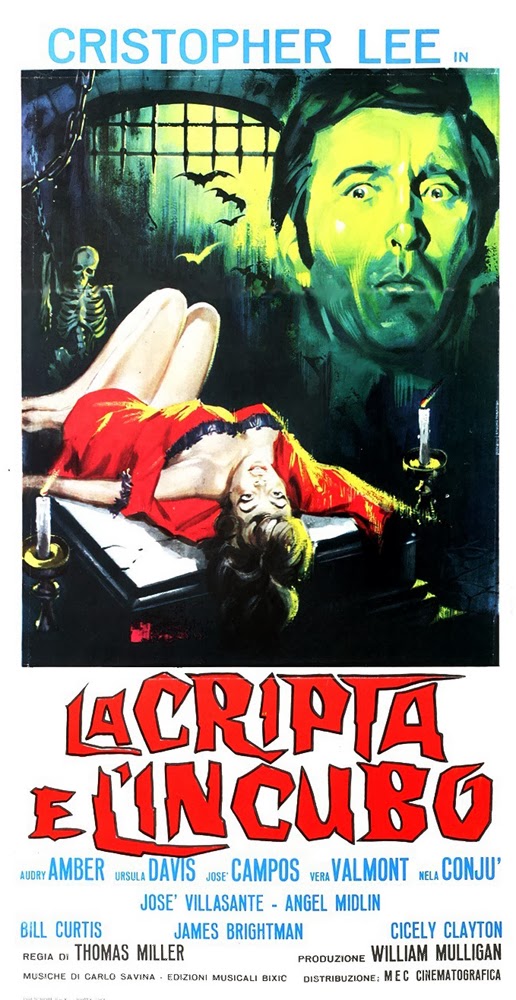
Crypt of the Vampire (1964) [La cripta e l'incubo aka Terror in the Crypt; Crypt of Horror]
Dir: Camillo Mastrocinque
TC4P Rating: 5

If you have seen and loved Roger Vadim's Blood and Roses (1960) as I have and do, then this Spanish-Italian version of Sheridan Le Fanu's novella, Carmilla will likely pale in comparison to the more famous earlier film. But it is a worthwhile rendering of its own, even if most character names have been changed, some bad dubbing is to be endured, and the director more than once betrays his obvious influencing by Mario Bava (never a bad thing).


Christopher Lee gets a heroic role this time, albeit a tortured one, and as in villainous roles, he has enough talent and range to pull the part off just fine. As Count Karnstein, he has to do battle against the light lesbian leanings of a mysterious vampire who is leaving drained bodies in her wake. It could be his daughter, who may be the reincarnation of an ancestor rumored to have committed such crimes, or it could be her recent companion, who has instilled herself into the daily life of the castle. The black and white cinematography is routinely effective if not spectacular, the sets and darkness of the castle are nicely rendered, and the heavy breathing, haunted ladies look divine onscreen.

This is the one of the three of these films where I am closest to giving it a higher rating, if only because it is the least gratuitous of the trio. This is likely due to it coming from a less permissive time in cinema (and just a handful of years earlier), so it relies more on subtlety and suggestion. However, there is a grandly gruesome sequence involving a dog tugging on the foot of a hanged peddler with his hand severed. Yes, it is derivative of Bava, but when a witch is seen using that hand as a candelabra in the very next scene while she invokes a spell, then you will know the film is a keeper.

[Postscript: I have since watched both Torture Chamber of Dr. Sadism and Crypt of the Vampire again, and while I am keeping Torture Chamber's rating at "5," I have shifted Crypt up to a "6," which is my general rating for "good."]

The 50 Something or Other Songs of 2017: Part 2

In our last exciting episode, I reviewed tracks 50 through 31 on Rolling Stone's list of the Best 50 Songs of 2017 . How did those ...