Thursday, March 24, 2016

Visiting and Revisiting: Starcrash (1978) Pt. 1


"What in the universe is that?!" -- Stella Star (Caroline Munro), Starcrash

This is Part I of a two-part discussion about Luigi Cozzi's 1978 Italian "rip-off" of Star Wars, Starcrash. To read the second part of this article, visit my pal Aaron Lowe's Working Dead Productions website at http://bit.ly/1Ro6vqH.

Rik: Considering that we very nearly flirted with the heavens in our last discussion regarding Hirokazu Kore-eda's After Life [Wandâfuru raifu], I am crashing us right back down to earth by making us jump over to a "Z" picture like Starcrash. But when I found out that you had never seen the film, it seemed like perfect fodder for our Visiting and Revisiting column that we share across both of our websites. For the uninitiated, in Visiting and Revisiting with Rik and Aaron, we hold a prolonged discussion/dual review about a film of which one of us has a long and possibly intimate history but that the other one has never seen previously.

There is no point in my life where I could admit, after having seen it, that I thought Luigi Cozzi's Starcrash was what most would consider to be a "good" film. Despite some fun and often very silly effects, crazy set design, and a mostly game cast, the Italian-made Starcrash betrays at every turn its third-rate inspiration (and often outright burglary) derived from practically every science-fiction and fantasy film that ever came down the pike, but most especially the original Star Wars film, released to great and never-ending acclaim the year previous in 1977.

However, there was a point where I truly believed that Starcrash was going to turn out to be a great film. In the years of 1978 and 1979, long before the internet, the primary way that a young movie fan such as myself got all fired up for films that were yet to be released, outside of trailers shown at the movies and on TV, was through movie magazines. In my teen years, I was a huge fan of the later years of the original run of the highly influential Famous Monsters of Filmland. Around the same time that I was discovering Hammer horror films on late night TV and other science fiction classics on an afternoon matinee TV show, I had begun an addiction to Famous Monsters. I had no way of knowing that many of the articles were merely reprints of older material, but there were also articles about upcoming films. So what did I care when they were written? All of it was new to me, and I lapped it up like the aspiring horror novice that I was. Other magazines caught my eye -- titles like Starlog and Fantastic Films -- and unlike Famous Monsters -- which was cheap and pretty much newsprint -- these other mags were slick and in gorgeous full color with loads of photographs.

When I read those magazines and saw my first images of Caroline Munro dressed up in leather as Stella Star in the movie Starcrash, I knew instantly that I just had to see this picture. As a not quite teenage boy chock full of raging hormones, I was already deep in adoration over Ms. Munro. She was among my earliest crushes, and ranked pretty highly at that. I had already seen her on the movie screen in such films as The Golden Voyage of Sinbad, At the Earth's Core, and The Spy Who Loved Me. In that last film, she was way hotter than Barbara Bach, but Bond dispatches her without a second thought while he makes off with Bach in his submarine car.) That Caroline was usually quite scantily clad in these parts made her all the more memorable, and like any youth in his near-to-early teen years, I was smitten. Starcrash summed it all up for me. I just had to see this film... but not just for Caroline. The images I saw in the movie magazines not only showed her in wonderful, lascivious detail, but also shots of the spaceships, and a giant robot chasing our heroine, and a lightsaber battle against two other robots. Even then, I knew it was clearly ripping off Star Wars (which I had already seen three or four times), but I didn't care. If Starcrash could get even somewhat close to replicating the style of the far superior film, then that would be all I needed. And Starcrash also had Caroline. How could it possibly be bad?


In 1979, after months of wondering whether I would ever get to see this film (we were not quite to the moment where video madness would change everything for me), Starcrash was released in America. Luckily, the film actually showed up in Anchorage, Alaska -- my hometown, though I grew up in a nearby town called Eagle River (to this day, it pisses me off to be told that Eagle River is merely a suburb of Anchorage, especially since there are 14 miles of unconnected wilderness between the two locations) -- and I went on a frantic campaign to get my family to go see Starcrash. My mother knew exactly why I wanted to see the film, but she was fine with me being all pervy about an actress twice my age. She drove us to the Totem Theatres in Anchorage for a night at the movies. In those waning days of the cinema double feature, Starcrash was paired up with Future World, which was also exciting to me since I had only recently seen Westworld on TV, and Future World was its direct sequel. But my mom opted to see another film that I don't remember, only that the second bill feature for that pairing was Old Dracula with David Niven. My brother Mark chose to go with my mom, and my youngest brother Chris stuck with me. But not for long, as it goes, as Chris grew bored very quickly with Future World, which we saw first, and I had to escort him to the other screen to leave him with my mom and Mark. (I remember being angry then, just as I would be today, that I missed a couple minutes of screen time to perform this task of familial responsibility.)


And my reaction to Starcrash? I was dumbfounded. The movie that I was sure was going to be a masterpiece was nothing but complete crap. Trying to show my mom that I had made the right decision that day and they were all fools for watching the other films (hey, Old Dracula is still no treat) I feigned joy openly at what confronted me in the theatre that day. Inside me, however, I believe it was the first time in my memory that I was actually sorely disappointed in a trip to the theatre. Seeing a movie in a theatre, even though the frequency went way up in my teen years, was still something of a novelty to me, having grown up in a smaller town outside of Anchorage where there were no real movie houses. I cherished every chance I got to go to the movies. (This is probably why I remember most of my visits so sharply.) But then it happened... Future World was nowhere near as cool as Westworld, and even then, the sense of being caught in an inferior, dull rehash swept over me. And after that debacle, Starcrash thoroughly broke my heart...

Aaron, I will relate the details of my initial disappointment at the film throughout our comments to come. But first, knowing that you have never seen the film before, I've been wondering if Starcrash has ever even been on your radar leading up to this moment. Had you heard of Starcrash before or did I hit you from out of deep space when I asked you about it?


Aaron: It’s quite possible that I had heard of Starcrash before, since, like you, I grew up reading a variety of film magazines, chief among them Starlog. Though of course I would have been reading about it as a reference point, or possibly a retrospective piece. To this day I’m an avid reader of books about film, video guides, and retro cinema websites, so it’s almost certain that at some point the title Starcrash had entered into my personal orbit. And yet the first time I actually remember hearing about the film was when you mentioned it to me, and I recall picturing one of those cheap Mill Creek sets of films that have fallen through the cracks in the United States copyright code. Then you mentioned Marjoe Gortner had a prominent part in the film, and I knew I had to see it. I’ve had a small fascination with this odd, middling actor ever since seeing the documentary about his child-preacher background and career as a revival preacher (titled simply Marjoe) that led to his brief moment of fame in the late ‘70s (though he continued acting until 1995).

So when you gave me with the Blu-ray this last Christmas, the packaging alone surprised me. Scream Factory has a bad habit of creating packaging that promises much more than the films can deliver, but even knowing that I was amazed by the design, and the smorgasbord of extras that were included. It appeared as if I had completely misjudged the level of quality Starcrash achieved, and the cult that had grown up around it. I remember I watched it pretty quickly after receiving it, maybe a day or two, but certainly on my next full day off work it was the first thing I popped into the Blu-ray player. I’ll get into my own reactions to the film as we go along as well, but at the time the only information I had about the film was gleaned from the painted cover it came wrapped in. I didn’t even read the plot description; I wanted to have a fresh experience with it.


Rik: Let's get to the basic plot. Starcrash concerns the adventures of Stella Star, a space-crossing heroine who zooms around in her starship alongside her companions, the strangely super-powered Akton (as Aaron mentioned, former child evangelist turned actor, Marjoe Gortner) and her robot bodyguard Elle (played by Munro's then-husband, Judd Hamilton). Like Han Solo, Stella is a smuggler and on the run from the law, but she is given a chance at clemency by the Galactic Emperor (a greatly slumming Christopher Plummer, who apparently did the part so he could spend time in Rome) if she will help him recover his missing son and also seek out the source of the weapon of mass destruction that the evil Count Zarth Arn has been using in his attacks on the Emperor's fleet. The Count is played with mustache-twirling sliminess by none other than Joe Spinell, a character actor who appeared in the first couple films in The Godfather and Rocky series. Spinell later gained film infamy for his role in the ultra-gory, female-scalping, horror epic, Madman (which also co-starred Caroline Munro).

At the outset of the film, the Count uses his weapon on a Galactic starship, which explodes from the attack, but not before ejecting three escape pods, one of which might contain the Galactic Prince Simon (David Hasselhoff... yes, that David Hasselhoff). The pods each land on a different planet, and so Stella and her crew skip from one to the next. They will encounter subzero temperatures, internal betrayal, Amazon warriors, barbarian cavemen, sword-wielding robots, and attacks by the Count's minions. Can they save the Galaxy? Did they save the Galaxy for you, Aaron?

Aaron: Well, here’s where I tell you to brace for disappointment, because I did not enjoy Starcrash on my initial viewing. Even in an ironic fashion, I found little enjoyment out of the film. Stick with me here, because I think I’ll bring you back around in a minute. On my first attempt at watching the film I kept falling asleep, and I had to restart the movie in order to give it a fair shake (I figured I owed it, and you, at least that much). But in the end, I found myself mystified by your excitement for the film, and surprised by the lavish, lovingly prepared 2-Disc Blu-ray set you gifted me with. The film not only felt near-criminally derivative (and not just of Star Wars, but almost every major sci-fi/fantasy work you could think of), but also very slapdash in its presentation. The care that went into designing some of the sets and spaceships didn’t quite mask how threadbare they looked upon construction, and plot-wise, events seem to just occur with no sense of drama or forward motion. There’s no real cause and effect in Starcrash. While ostensibly the plot boils down to ‘save the Emperor’s son and stop Zarth Arn from deploying his horrific weapon,’ those two acts come across as fairly unrelated. Instead we follow Stella, Akton, and Elle from location to location, event to event, and it’s all fairly lifeless and lacking in forward momentum. If you go back and watch the original Star Wars (which was clearly the template over which Starcrash was laid, though Luigi Cozzi would claim otherwise), it’s easy to notice how incident-free it is, how relatively light on story. And yet it has a simple unifying goal and a strong sense of drive that Starcrash is lacking, though more ‘things’ happen in that latter film.
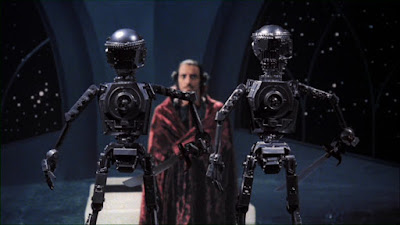


So I didn’t like the film, but I was curious as to what had given the film such a warm place in your heart. Beyond, of course, childhood nostalgia and the overall effect Caroline Munro had as she helped usher you from child to awkward hormonal teenager. To that end I began digging into the movie’s special features (I said it before, but it bears repeating; the presentation of this film on Blu-ray is opulent to a ridiculous degree for a film that might otherwise be called inessential), and one special feature in particular really hammered it home for me: Joe Dante’s commentary for the trailer. Joe Dante used to edit trailers for AIP, and the last trailer he ever put together was the American trailer for Starcrash. He talks a bit on the commentary about how Starcrash is not a very good film, but that it has some really neat visuals, so he decided to focus solely on the visuals and cut together a two-and- a-half minute music video featuring wordless clips from the movie set to John Barry’s score. Suddenly it all seemed to click, and hearing Joe Dante speak about the visual merits of the film while seeing a procession of cherry picked images made me realize that perhaps I had been ignoring the film’s true merits. [Editor's note: Here is the trailer below, shown on the Trailers from Hell YouTube channel, featuring comments by Eli Roth. To hear Dante's commentary, you will have to check out the DVD or Blu-ray...]


On a second viewing, Starcrash performed much more admirably. I’m in agreement with you that it will never quite meet the qualifications for ‘good,’ but it certainly met the requirements for ‘fun.’ I started paying closer attention to design elements, color schemes, references to older (and often better) sci-fi films. Little details stood out, like that weird revolving hallway on the imperial ship in the beginning of the film, where you walk into a room, hit a button, and wait for the room to do a 180 degree turn so you can continue on your way. Why not just remove the middle man? We see people enter from both sides, and it doesn’t appear to be a security measure. It’s just one of those additions that are supposed to make everything look more futuristic. What could be cooler and more futuristic than a hallway with a slow-moving Lazy Susan in the middle of it? Once I stopped worrying about story or plot or even acting, everything became much better. That sounds like very faint praise indeed, but a fun bad film is still better than a boring good one.


One thing I did both times I watched the film was play ‘spot the Star Wars analog,’ which was never a very hard thing to do. Some of them are really obvious, like the always-worrying robot companion or the trademark-taunting name of the villain, Zarth Arn. You mention the similarities between Han Solo and Stella Star, but I initially felt that Akton would be the Han Solo figure, since he has early dialogue about being a simple smuggler, and what could be seen as an oblique rejoinder to one of Han Solo’s most famous character traits from the first Star Wars. When Stella and Akton are about to make a particularly risky move, Stella wonders aloud what the chances of success would be, and Akton begins to rattle off a detailed list of all the possible outcomes and the exact probability of their occurrence. It could just be a coincidence, but I like to think that the film is making an intentional swipe at Han Solo’s ‘never tell me the odds’ line. But then, of course, Akton turns out to be more of an Obi Wan Kenobi figure, with a very vaguely defined set of powers derived from his religion.

Part II of this discussion can be found on Aaron's blog, Working Dead Productions, by following this link: http://bit.ly/1Ro6vqH.

Tuesday, March 22, 2016

New Pylon Guest Wonderfulness Over at the Rupert Pupkin Blog!

It has been a little bit since I have posted here. This has been due to an ongoing illness of which I am just now starting to recover, thanks to a series of helpful doctors and any number of medical procedures and prescriptions. I am not yet 100%, but I seem to be working my way back to health, and will hopefully at least have a firm grip on learning to live with my particular disease in the next couple of weeks. There are still some doctor visits ahead, which will hopefully include the formulation of a plan of attack that will see my feeling much better soon.

The past seven weeks or so has been pretty much a wash for me, and I have been largely unable to sit at a computer for more than a few minutes at a time. Thus, there has been zero output across any of my numerous websites. Luckily, many weeks ago at the outset of my illness, my pal Brian Saur asked me for a new list for his Rupert Pupkin Speaks blog. The topic was "Underrated Films of 1996". A few films came to mind right away, and because I was not yet quite in the pain and state of fear that I would be a handful of days later, I was able to churn out a short piece featuring four favorite films from 1996 of which I was particularly enamored and that I wish more people had paid more attention to at the time.

Rik Tod Johnson's Underrated Films of 1996
Check out the list on Brian's blog, and while you are there, please check out some of the other lists provided by our fellow cinephiles, some of whom are fairly well-known (and sometimes quite well-known) directors, writers, and critics. And some of them are just regular Joes like me. What we share is a great love of cinema (both highbrow and lowbrow) and a need to shout out loud when we find something we love. And for goodness sake, please leave comments!

Brian recently posted a couple of other lists that I created and wrote about for his site. Here are the links:

Film Discoveries of 2015
http://www.rupertpupkinspeaks.com/2016/01/film-discoveries-of-2015-rik-tod-johnson.html

Underrated Films of 1945

Also completed (primarily) before I got sick was the next installment of Visiting and Revisiting, a shared column with my writing partner, Aaron Lowe. The new column is about the 1978 Italian sci-fi cult classic, Starcrash, starring the voluptuous (and sadly dubbed) Caroline Munro. I will probably post my opening half of the column tomorrow (Wednesday, March 23) and then Aaron will follow suit on his blog, Working Dead Productions, with the second half. We will announce on our social media pages when the posts are live.

Take care, and it is good to be (mostly) back.

Thanks!

RTJ

Sunday, February 14, 2016

Scalias and Arpeggios


My friends on all sides of the political divide in this country seem to have weighed in already on the death of Justice Antonin Scalia.

Some of the responses have been expected. For those on the left, Scalia represented a form of ultimate bogeyman — a monstrous villain who held the rights and freedom of various interest groups in check with an almost playful (and endlessly erudite) glee. It was not surprising to see “Ding, Dong, the witch is dead!” statements all over Facebook and Twitter, the social media equivalent of burning someone in effigy, I suppose.

On the right, the responses I have seen have been more measured, less coated in emotional release and more (on what seems to my eyes) to be a concentrated effort to make themselves look like the better person for not reveling in the death of someone on the other side of the political tug of war that this country has become.

If you don’t like how I just worded that, keep in mind that before I am (politically) a liberal, I am a cynic. It takes a lot for me to trust even a little of what I read on Facebook, unless the people that are saying those things are my actual friends. And not just “friends” in Facebook parlance, which often means mere acquaintances, the acquaintances of your actual friends, or relatives that you haven’t seen in years and that you have barely made the effort to know at all. But I know that some of these responses are driven purely by the character of certain friends, such as my dear pal Shane's response (below), which is in keeping with how I know the man and his open and good heart. Politically, theologically, artistically, and philosophically, Shane and I may not agree on very much at all. But we both love monster movies and a cold Dr. Pepper, so why should all this other junk matter?


I will admit, when I received the news by text that Scalia had died yesterday, my immediate reaction was “Wow!” I thought of the open spot on the Supreme Court, and how hard it is going to be to fill that seat — not just by Obama, but possibly by his replacement, should the very obviously prolonged battle to fill it take that long. I also thought, “Scalia was a fucking asshole,” but I refrained (until now, I guess) from posting it on social media. Of course, I didn’t know actually know the guy. I was mainly basing my opinion on years of what I saw online, on television, and in newspapers and magazines. Oh yeah, and on his court record. I can’t tell you if he was actually a jerk in real life, or just a highly educated, highly experienced guy who held different opinions than me generally. Besides, many people consider me a fucking asshole too. So, pot… kettle… black. Who am I to judge?

Please bear in mind, just a few short weeks ago, a huge cross-section of humanity seemed to have forgotten all this political folderol and joined hands (figuratively) in lamenting the death of David Bowie. We cried, we played his videos and his music, we posted pictures of him in drag or in movie roles, and we commiserated as fans of an undeniably enormous talent over his loss to our world. The refrain that I saw many times over the course of a few days was (in various configurations, but summarized here): “Why did David Bowie have to die? Why didn’t God take one of the world’s biggest assholes instead, like Trump or Manson?”

The problem in a statement like this is two-fold. One, assholes have fans too. For reasons absolutely unclear to me, a lot of people love Trump, as we have been discovering (sadly). Manson was a murderous charismatic who wanted to start a race war and he still holds a strange ability to mesmerize people. Two, not everybody liked David Bowie. A lot of people thought he was weird, didn’t like his music, and didn’t like his flaunted sexuality (whatever it happened to be at that point in time). I know rock critics who savaged him for years, and like any celebrity, the man has his detractors. There are probably people who will still tell you what a jerk he was for, say, not tipping properly at a restaurant in 1977 when he was all coked out one time. There are people who tell stories like that about every celebrity, artist, or politician, no matter how revered.

No one is beloved 100% of the time and no one is hated that way either. As Shane mentioned, Scalia had family and friends who are most likely greatly saddened by his loss. (Again, it’s a case where we don’t know them personally, so we can’t know for sure.) Yes, it is highly probable that none of his family members follow you on Facebook or Twitter, so the chances that they are ever going to happen upon your joyful ranting about “the world losing a rotten human being” is pretty slim.

But the thing about social media is that it is “social”. Things get retweeted and passed around. Eventually, the media picks up on them, and often reports items along the lines of “Twitter is ablaze with people cheering on the death of Antonin Scalia!” The guy had nine children and 36 grandchildren, a considerably extended immediate family. Is it fair to them if news like this reaches their ears? Sure, you may not like how he voted on abortion rights, but it’s not his family’s fault that he was who he was. They didn’t sit on that court.

So, I might be happy that there is an open spot on the Supreme Court, but am I happy that Scalia is dead? No. I don’t like it when anybody dies, unless it is someone that I really, really hate on a personal level. You see, I know that jerk and when he goes, I am going to dig an extra hole by his grave so I can kick him in the side from time to time. But I didn’t know Scalia, so I shouldn’t have a care except to say I am sorry for his loved ones. It’s what we would wish others to say for us should we go. It’s the least we can do in return.

And for an interesting 2014 take on Scalia, read this article…

http://www.slate.com/articles/news_and_politics/jurisprudence/2014/09/justice_antonin_scalia_s_brilliant_liberal_moments_on_the_supreme_court.html

Saturday, February 06, 2016

The Shark Film Office [007 Edition]: Licence to Kill (1989)

Licence to Kill (1989)
Dir.: John Glen
TC4P Rating: 6/9
Species: Great white shark (Carcharodon carcharias); blacktip reef shark (
Carcharhinus melanopterus); Sharkey (Frank McRae); manta ray (Timothy Dalton)
James Bond specimen: Timothy Dalton

Sharks and James Bond. Like chocolate and peanut butter. At least, that's the way it seemed for quite a few years. Thunderball (1965), Live and Let Die (1973), The Spy Who Loved Me (1977), and For Your Eyes Only (1981) all contain scenes where sharks are used as a menacing element, usually (but not always) kept in tanks by Bond's enemies for reasons of torture or dispatching of victims. In my head, I always lump the truly insane, Connery race-changing epic, You Only Live Twice into this bunch, but always have to remind myself that the deadly creatures in Blofeld's lair are piranhas, not sharks. Same concept; entirely different fish.

Hell, Bond even has a nemesis (and eventual ally, briefly) named Jaws, a giant of a man (Richard Kiel) with razor sharp metal teeth who gets the rare distinction of getting to appear in consecutive films in the series. Living up to his name, he even bites a tiger shark to death in his first film, The Spy Who Loved Me. (And we get "Jaws in Space" in the immediate followup, Moonraker.)

Let's get back to the actual fish. Where this immensely popular film series was once rife with appearances by our finny fellows, sharks have rather gone to the wayside in the last 25 years of Bond films. The Pierce Brosnan and Daniel Craig films have been totally lacking in sharky menace, and this may be due to public perception of sharks as villains being turned on its head in the mainstream. We know that this isn't true on the video shelves or on cable channels, where there are ceaseless iterations of Z-level shark attack films and even the viral hits from SyFy's Sharknado and Sharktopus series. Perhaps the James Bond films are just too, too huge to risk riling up the animal rights activists, whereas much lower (and sillier seeming) projects can slip by unnoticed.

But James Bond did take one last crack at villains using captured sharks to do their business, 1989's Licence to Kill, the second and final outing featuring Timothy Dalton in the 007 role. In attempting to turn the series in a darker, more realistic direction, frequent Bond helmer, John Glen, is only partly successful. What wasn't successful was the film's box office success, where it continues to rank very low on the list of Bond breadwinners. Because of this, Dalton was done, and there wouldn't be another 007 film for a full six years, the largest break in the run of a series that has continued to churn out super-spy thrillers since 1962. Brosnan and director Martin Campbell would reenergize the series in 1995 with Goldeneye, and it has continued to be an ever bigger success since. (Not that there weren't a couple of duds in there.)

The full plot of Licence to Kill is really inconsequential to our purposes here, but a slight wedge of it would be helpful in establishing some of the characters involved in the film's shark-related suspense. Bond visits Key West, Florida on vacation to act as the best man in his longtime pal Felix Leiter's wedding. Leiter (played here by David Hedison) is basically meant to represent the American version of Bond, and has been a mainstay in Bond films since Jack Lord played him in Dr. No. This is actually Hedison's second time playing the character (one of two actors to do so, the other being Jeffrey Wright), though he was played by John Terry in the previous film to Licence, The Living Daylights.

Things go awry when slimy drug kingpin Sanchez (played by Robert Davi) has his henchmen spring him from CIA custody (the opening sequence of the film involves his capture by Leiter and Bond, after which they parachute down to Leiter's wedding). Sanchez hides out in a scientific research aquarium run by another slimeball, Milton Krest (Anthony Zerbe aka the mad scientist from KISS Meets the Phantom of the Park), but shortly after the wedding, Sanchez and his thugs capture Leiter, savagely killing his new wife in the process. In the company of a DEA agent on the take, Ed Killifer (Everett McGill, Big Ed from Twin Peaks), as well as a young and relatively baby-faced Benicio del Toro, Sanchez hangs Leiter over a trap door built into the floor of the aquarium. In the tank is a large great white shark they have captured. After first enticing the shark with a side of something on a hook, Sanchez has Felix lowered into the tank, where the great white starts to feed on him.

Yes, it is supposed to be a great white shark, but it doesn't always look that way. In the usual way of Hollywood/British shark movies, shark species were still considered pretty interchangeable, despite their massive differences in size and looks, and the first shot we get of a real shark seems to be more of a tiger shark, as it glides forward through a tank. (The nose is too flat and broad for one thing.) However, the puppet shark head that is used for closeups, and which gets employed several times coming up, is very clearly modeled after a great white. Regardless of which shark it is, the shark character does its job. Felix loses his leg, and is carried back to his hotel suite where Bond will discover Leiter's wife's dead body on the bed, while Felix is also found by James, still breathing, wrapped up in a sheet on the couch. James finds a bloody note tucked into Felix's shirt that reads, in the tradition of bad Bond puns, "He disagreed with something that ate him."

I have heard people get upset about Felix's fate in this film (he lives, by the way), but it is not nearly as bad as that which occurs in the second of the original Ian Fleming Bond books, Live and Let Die. In fact, this film drew inspiration directly from that book, using elements that were never used in the film adaptation of the same name. Chiefly, having Felix Leiter getting attacked by a shark while losing an arm and a leg in the process. That's right... Felix gets it even worse in the book, but just like in this film, he lives to tell the tale. And the punning note is in the book as well.

Getting back to Licence, Bond has a buddy who has a name just dripping with foreshadowing and also entirely locale appropriate, Sharkey (played by Frank McRae, a familiar face from Cannery Row and Red Dawn). Sharkey, in addition to being an agent, also runs a charter boat service that specializes in shark fishing. Sharkey and Bond sneak back to the aquarium after Bond proclaims, "Let's go shark fishing!" As Bond makes his way across from grated flooring above the water, he is startled and pushed back by the head of the great white shark coming up through the grates. Bond collects himself and makes his way up a ladder into the air, while Sharkey remains on their craft to eye suspiciously the lurking shark. Bond passes a series of small aquarium tanks inside and we briefly get the one shot where Dalton and a real shark are in the same frame, a small blacktip reef shark swimming benignly about for some local flavor.

Suddenly, Bond is intercepted by Killifer (McGill), who is skulking about carrying a briefcase containing two million dollars. Killifer triggers the mechanism for the trap door containing the great white, but he is tripped up as Sharkey opens another trap door. Killifer falls towards the open tank and grabs onto a rope. With the great white snapping just below his dangling legs, Killifer offers to split the money with Bond, but James throws the briefcase at him, causing him to lose his grip and give the great white (not really a great white) a fairly decent meal. Eyeing the carnage, Sharkey shakes his head in disgust and says, "What a terrible waste... of money."

A short while later, M arrives from London and Bond is ordered to Turkey for another assignment. Bond refuses and quits MI6, and has his "license to kill" revoked by his boss. Ordered under arrest, Bond escapes, swearing vengeance against Sanchez. Later, at the hideout, a submersible craft used by the drug runners to carrying out their business encounters what looks like a manta ray swimming along the ocean floor. They are ordered by Krest to ignore it, but this will turn out to be a mistake. The manta ray is really a clever and very improbable disguise worn by Bond to take control of one of their other submersibles so he can sneak into their hideout.

After getting into all sorts of mischief that I won't detail here, he ends up in the boudoir (naturally) of Sanchez's abused girlfriend, Lupe Lamora (Talisa Soto). Finding no interference from her, as Bond makes to leave, he spies the now dead Sharkey hanging on the back of his charter boat, alongside a pair of small sharks that were caught earlier. Bond steps out of the bedroom and shoots one of the thugs controlling the charter boat through the stomach with a speargun, yelling, "This is for Sharkey!"

For the first time since The Spy Who Loved Me, the use of sharks and shark references (though quite lazy at that) actually figure fairly prominently in the plot of a Bond film. All of this shark nonsense occurs in the first 46 minutes of the film. The locale switches for the next portion to a casino in Vegas, but even though Bond and company return to Key West after that and engage in even more underwater action, the shark stuff is done for the film.

The remainder of Licence to Kill is all about Bond undercover as he earns the trust of the drug lord Sanchez somehow and then shatters his plot to hide cocaine inside gasoline and take over the drug trade in a still pretty rousing action finale using tanker trucks (and clearly influenced by the Mad Max films). Just don't ask me how in hell they got that one truck to balance on the wheels on one side like that (to avoid a missile); not just the truck but the tank as well. (Really... it's pretty crazy.)

I didn't even get to anything involving Carey Lowell, as a girl that Bond recruits to help him, and of course, to eventually get in the sack. Lowell, early in her career, is fairly stiff here as an actress, but man, is she cute. I fell in love with her instantly when I saw this movie in a theatre upon its release, and I was happy to learn that I still think she is a cupcake. Bond thinks so too, especially when she strips down to a still amazing swimsuit/lingerie (I have never been sure which) as they set up Krest for a violent fall. It's a one piece, but you won't remember that. And the looks that Dalton gives her as she reveals her swimsuit (and pretty much the rest of her) are about as dirty and leering as they get.

But this is the funny part. My memories of Carey Lowell in this film involve her being in the scenes where the great white comes up through the grates (maybe it is actually a "grate white"?) and where the trap door is opened, not Sharkey. I saw the film twice back then, but it has been many years since I saw it all the way through. Clearly, time has eroded my memory of the film, so it was good to get everything back in place again. 

Another image that had changed in my mind was the actual shot of the shark sticking its head up from the water. I had obviously supplanted it with other more recent imagery of sharks (possibly from documentaries) rising from the water, so when I watched Licence to Kill again, the picture just didn't seem right. It almost felt like there was some Lucas-style post-tampering going on here. Of course, there wasn't, because they would then use modern CGI to amp the shark up a tad and the whole thing would probably look even worse. Sorry, but I will take the shark puppet head any time.

RTJ

If you liked this piece, and would like to read more articles about sharks and other ocean species in film, please visit The Shark Film Office site at http://sharkfilmoffice.blogspot.com/.

Thursday, January 28, 2016

Introducing My New Food Allergy Blog... Intelli-Allergentsia!

I just started a new blog about food allergies called Intelli-Allergentsia. Visit http://intelli-allergentsia.blogspot.com/…/the-road-less-sw… to read the first part of my telling how I found myself suddenly plunged into the wheat-free world.

Eventually, I hope to include food reviews, restaurant reviews, and general discussion of other food allergen groups beyond mine (wheat, rye, shellfish, and codfish). I may even solicit articles from my friends with similar problems in the future so that they can tell their stories or give their observations.

Please feel free to leave comments on there as well. I want this conversation to continue, and we will all have an easier time negotiating the food alternative world when we share. If there are wheat or gluten-free food products you would like me to review, or restaurants in the Southern California area that have good gluten-free options, please throw me your suggestions if you'd like.


And if you are someone who just automatically thinks this is me being trendy, you should probably take the time to read the full article (in three parts) when it has been posted to see how wrong you are. Not everybody is a hipster. Not everybody does things just because they think it makes them feel better. Not everyone asks questions or for special menus in restaurants because they crave being the center of attention. It's embarrassing.

I would eat a regular cheeseburger right now with real, honest to goodness bread full of wheat flour if I could be assured that I wasn't going to projectile vomit it across the room twenty minutes later. And then cough endlessly for the next four hours. Shut up and read the story...


Thanks!

RTJ

Sunday, January 24, 2016

Head On Over to Rupert Pupkin Speaks for More Pylon Goodness!

A short post here where it seems like I am tooting my own horn (which I am to a large degree), but mainly I want to direct anybody that frequents my blog to visit the Rupert Pupkin Speaks blog instead.

My friend Brian, who runs the site, has posted a piece today that I wrote on the topic "Film Discoveries of 2015". These are films, older than the year 2000, that I saw for the very first time in 2015 and that made an impression on me when I watched them. I selected five that I felt were of high and enduring quality that pleased me greatly, but then threw in a really Grade-Z, ultra low-budget monster flick from the '70s at the end of the article that I found to be particularly memorable and entertaining.

Rik Tod Johnson's Film Discoveries of 2015

I hope that you enjoy my article, and while you are on Brian's site, please check out many of the other writers who have contributed their articles on this same topic since the start of the year. There are directors, screenwriters, critics, and many other fellow cinephiles who have written of their favorite new discoveries. The most incredible part is that, because everyone's cinematic journey is entirely different, there are few (if any) repeats mentioned across all of the lists.

Brian posted an earlier piece of mine in December that you can also read here:

I hope that you enjoy my article, and please leave a comment on Brian's blog while you are at it.

Thanks!

RTJ

Friday, January 22, 2016

A Visiting and Revisiting Special: Boycott the 2016 Academy Awards? Pt. 1


There is a good chance that very few people in the Western Hemisphere, and a good many of them beyond, don't already have an opinion about the lack of artists of color in the Academy Award nominations this year. Whether luck of the draw or the system being broken and needing a good fix, having two years in a row where several prominent performances by non-white actors and actresses have gone unacknowledged by the Academy looks pretty bad to most people that care about these things.

My writing partner, Aaron Lowe (Working Dead Productions) and I have decided to discuss this topic in lieu of our usual back and forth conversations on a particular movie in our Visiting and Revisiting feature that we split between our respective websites. To put it out front, we are both Caucasian and male. My politics are outspokenly liberal (though I believe that a centrist position is the best way to get things done in Washington), and Aaron identifies as "pretty strongly liberal" (his words). 


So, you are not going to get a William F. Buckley Jr. vs. Gore Vidal-style point-counterpoint here. What we wanted to do was actually think through the problem and see what lies at the heart of it, determine whether a large-scale, knee-jerk reaction boycott would do any good, and see what possible solutions there could be so that not only are all sides appeased, but that the situation rights itself for the future.

1. Do you believe that the actions (to this point) of the Academy point to systemic racism, or do you feel that the list of nominees from the past two years is simply "the luck of the draw," given the fact that there have been past years where persons of color were nominated and even won?

Rik: When I wrote this question, I used the term "luck of the draw," but of course, I know it really doesn't come down to that at all. There is a nomination process that has been long in place, and it relies on the placement of nominees on each ballot after they first determine a "magic number" for each category, which itself is based on the total number of ballots divided by the number of possible nominees for that category plus one. The term "magic number" does ultimately denote a bit of luck because the selection of nominees does depend on the order in which the ballots get counted. The first candidate that reaches the required "magic number" gets the first slot on the nominee list, and so on until all the available slots for that category are filled. First come, first served.

So, do I think that the nominations are based directly on the racism within the Academy itself? I doubt it. To be sure, the Academy, like much of Hollywood, was built and is still largely based on an "old boys" network, that is -- like much of big business in America -- still terribly, predominately white and male. Yes, the USA is (as of the 2010 Census) 63+% non-Hispanic white, but the disparity within the Academy is even larger, with an LA Times study in 2012 finding that the group was likely to be 94% white, while men make up 77% of the membership overall. I think the biggest problem is that the film industry in America itself caters mainly to the white male audience. If you have 40 Oscar quality pictures released within a year (and that is pushing it; I am just using it as an example) and only a relative few are built around non-white themes or feature lead actors of non-white origin, then it makes the reality that one of those few films will get nominated a long-shot.

This is not to discount that there could be some old school, good old boy racism at play here. Maybe Hollywood isn't quite as left leaning as Fox News and its cohorts would like the American public to believe. There probably are many older members of the Academy -- and in 2012, 86% of them were over the age of 50, with the median age being 62 years old -- who harbor ancient racial resentments instilled in them since they were younger and raised in less enlightened times. I don't doubt that there are problem many in the membership who feel that way. It would be like with any slice of America that you cut, there is going to be a certain segment that leans a certain way.

I think a larger problem (in direct response to this question) is that within that older membership, that there is a likely disconnect between themes that are interesting to moviegoers today versus what those older members might want to see onscreen. It is more likely that this white, older chunk of the Academy may not be all that concerned with seeing the far fewer films per year featuring younger (or even established) actors and actresses of color in stories that don't necessary connect to that in which they are interested. These older members also might not want to see supposedly "heavier" films about African child warriors (Beasts of No Nation) or gang shootings in Chicago (Chi-raq), and they likely don't care at all about rap or hip-hop (Straight Outta Compton). In many ways it doesn't surprise me these films got zero or little attention from the Academy. The two films with black leads and/or creators that really had a shot should have been the highly acclaimed (and justly so) sports dramas, Creed and Concussion, and only Sylvester Stallone, a white actor, was nominated between them. Old white guys tend to like sports --- especially football and baseball -- but they may have reacted negatively to Concussion's casting of their beloved NFL as a secretive, villainous organization that doesn't care about the fate of its players as long as they keep the money flowing. (Which they are, but shhhhhhhhh...)

Aaron: To answer quickly, before going on to individual points: I believe the problem lies in the people, not the system. Surely the system has allowed a certain amount of stagnation to set in, but when I went to research how someone becomes an Academy member, and how the voting was handled, I found that it was remarkably fair and balanced, in the literal meaning of that phrase, not in the Fox News meaning. Obviously, the system favors those films and individuals with the largest amount of exposure, which leads to the predictable roundup of popular crowd-pleasers, but that’s the nature of popularity contests. In reality, a contender can come from anywhere, and the system itself is, essentially, colorblind.

I tend to believe that the average Academy member is not as racist as this year’s scandal would imply, and I doubt there’s a conspiracy here where large groups of white-haired old men decided to exclude performers of color. It’s just another case of a large group of people making individual choices; choices that they maybe don’t realize are quite so exclusive. I might be giving these people too much credit, but generally speaking I don’t assume people are mustache-twirling villains. That doesn’t really come as any consolation, and in fact may be worse; if people were doing this consciously we could easily say it was wrong, but if people are doing this with good intentions, it’ll be harder to fix.

The demographic argument about the Academy –that they are older white men and stuck in their ways- rings a bit false to me. Let’s say the median age right now is 66; this means these people came of age during the civil rights movement, and they likely came out of leftist leaning film schools in the 70s; George Lucas and Steven Spielberg, for example. George Miller is in his seventies and he just made one of the most feminist -- not to mention energetic and truly wild -- action movies of all time. I know those people are outliers, but when we talk about how old the average Academy member is, it’s not as if they were raised in the antebellum South. 

But here’s another problem; people recognize and feel comfortable with what they know. There’s no big conspiracy here, but people making movies form relationships with people they get along with, and people they enjoy working with, and the entire system becomes a bit closed off and incestuous. It can be hard to break into that world. I don’t automatically assume racism when I hear about a writers’ room that is primarily white, or male, or what have you. I do assume that whoever put that room together was more interested in having a room full of people that he or she was comfortable working with than in having a room made up of diverse voices. I think that practice is being seen here, writ large. Academy members see things their friends worked on, they vote for things their friends worked on, or speak to their life in some way. And since the Academy is made up of so many older white men, you see a pretty whitewashed selection of films.

To answer another point you bring up; Hollywood is definitely not as left leaning as Fox News would like Middle America to believe. Hollywood is the very definition of capitalistic; they go where the money is. The problem is, the source of the money is changing, and the entertainment industry is incredibly slow to realize this. Look at the continuing controversies over the removal of strong female characters from the promotional materials for films such as the new Star Wars film or The Avengers. The entertainment industry just isn’t ready to accept the fact that there might be money in catering to, or at least acknowledging, a market other than 18-40 year old white males.

2. Do you think "Affirmative Action" should apply to supposedly exclusive and invite-only clubs, such as the Academy of Motion Picture Arts and Science?

Aaron: I’ve always been a bit uncomfortable with the term “Affirmative Action” and what it implies. I understand the motivations behind it, and they are truly noble, but it implies (whether accurately or not) a certain amount of racism on the other side of the coin. When people talk about Affirmative Action it’s usually implied that those benefitting from it aren’t quite deserving of the help; that they’ve only been included due to their skin color or ethnicity or gender. Of course, that’s exactly what has been happening with white people for hundreds of years, but it still carries a negative connotation.

The problem here is that Affirmative Action is completely unnecessary in this case. There’s no reason to invite members into the Academy based solely on the boxes they fill out on the census form. There’s also no cap to the number of members the Academy can have, so there’s no real reason to exclude anyone. There are plenty of talented and deserving individuals that the Academy is ignoring. Academy president Cheryl Boone Isaacs issued a statement promising to overhaul the Academy’s membership process, and actively recruit a more diverse crowd, which seems to me like a great start. They’ve done this in the past, when they tried to recruit a younger audience in the 60’s, and that seemed to work well for them at the time.

Rik: I feel Affirmative Action is still very necessary in the public and government sector. But should it be mandatory for private clubs and organizations? I'm not sure that anything should be done about that. If a particular group wants to keep their practices and meetings to an invited group only, I don't see the problem with that. But I also know I would not want to belong to such an organization if their inclusion process was based around standards that were openly racist or sexist. I know that I wouldn't want to belong to a club that was "men only," because what good is anything if there is not a chance of women being involved? (There is a certain irony that so many men brandish an oversized and often outspoken fear of homosexuality, but then really just want to hang out with other guys 90% of the time.) And what good is an organization that doles out awards to the best films within a calendar year if it doesn't have a membership that can recognize a certain portion of those "best films" because it is imbalanced?

3. What do you think would be a good, or even the best, solution towards broadening the membership of the Academy and making it at least reflect the demographic breakdown of America?

Rik: My solution for the Academy membership is to blow it up! By that, I mean make it much, much larger than it is right now (currently only 6,000+ members). I would switch it from invite-only to including all "active" members of the major Hollywood trade unions and guilds. This would include the Screen Actors Guild (including CON-AFTRA; they are combined now), the Directors Guild of America, the Writers Guild of America, the American Society of Cinematographers, the Producers Guild of America... all of them, as long as they are represented by one of the categories in which an award is given. Anyone that is a current member of the Academy but may not be active in one of the unions or guilds is allowed to remain (you have to give them some reason for living), but this will allow the Academy to include most of Hollywood's artists. Yes, it will put their membership at over 200,000 members (at least), and there will be logistical problems involved in developing a new nomination and voting process and the screening of nominated films, but that is their problem. If you want the Academy to represent the industry, then that is the quickest way.

Aaron: Honestly, that seems like such a logical idea that I was honestly surprised it wasn’t how the process worked already. Being a member of one of those unions automatically means that you are working as a professional, and have had at least one credit within the past year. I have to imagine that such an influx of younger, more diverse members would make an immediate impact.

To read Part II of this discussion, please click here.

The 50 Something or Other Songs of 2017: Part 2

In our last exciting episode, I reviewed tracks 50 through 31 on Rolling Stone's list of the Best 50 Songs of 2017 . How did those ...